
Bill Bruford
Ferocious Intensity
by Anil Prasad
Copyright © 1998 Anil Prasad. All rights reserved.
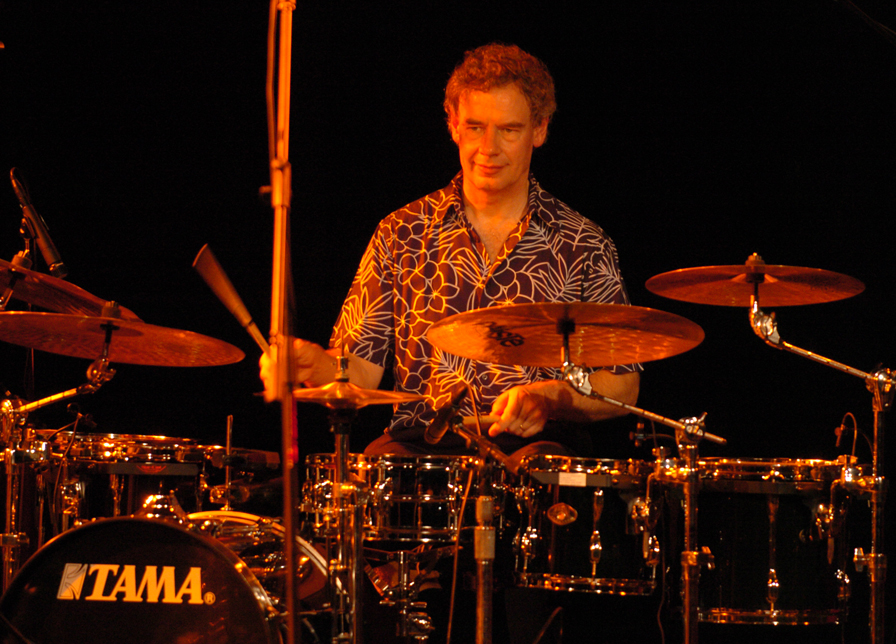
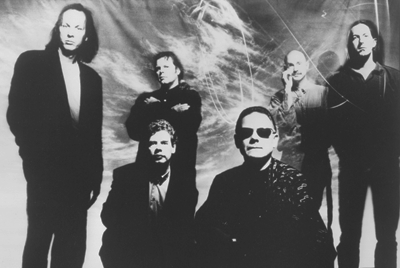
As he's done countless times before, drummer Bill Bruford is about to take the stage with King Crimson. Accompanying him are guitarist Robert Fripp, vocalist and bassist John Wetton, and violinist David Cross. The odd thing is Bruford and Fripp are the only current members of the band. Even stranger is the fact that there are no instruments. Only a few tables and a microphone are in view. That's because the purpose of this gathering at HMV Records in New York City is to promote The Night Watch, an archival concert recording from 1973, when this fiery incarnation was in full-flight.
During the event, the band indulged the crowd in a question and answer period, and an autograph session for hundreds of fans. While the focus of the gathering was about looking in the rear view mirror, Bruford continues to propel forward. His jazz group Earthworks has a new lineup featuring pianist Steve Hamilton, bassist Geoff Gascoigne and saxophonist Patrick Clahar. He's also performing with Projekct One, an all-improv King Crimson-related ensemble with Fripp, bassist Tony Levin, and touch guitarist Trey Gunn.
Thanks for taking the time to speak to me during such a manic day.
My pleasure. So is Innerviews a new music magazine?
That's the rumor on the street.
Just music then? Do you interview construction workers as well?
In some ways, you're a construction worker, aren't you?
Indeed so—a hard laborer, a man in the trenches, a foot soldier. [laughs] Being a touring musician is like being in the trenches during World War I sometimes. It's 90 percent boredom and 10 percent terror, as they say.
It's not even one percent enjoyment?
Oh, enjoyment? [laughs] That's around. Well, it used to be around anyway. It's still around when I set up the drums.
What are your thoughts about participating in the record signing you just did at HMV?
Things gets strange as life goes on, don't they? We were at HMV to sign a few zillion autographs on record sleeves that are 25 years old for God's sake. It has become an irritating thing to participate in these things. I don't mean it badly, but it's something you didn't bargain for when you joined the trade—this business of running for president every time you release an album. Every time you want to release any kind of artistic endeavor to the public in our saturated society, you've got to talk yourself into sickness to merely bring to their attention the fact that the art endeavor has been created. And that's apart from whether it's any good or bad, or if they can actually buy it or not. When I started, we didn't do that. We made the record and we released it. Fifteen years into my career, somebody asked "Would you like an interview?" and that was very novel—that was exciting because obviously, it meant we were famous. [laughs] But the way it is these days, you're given a piece of paper and it tells you that that's all there is for the next six months. No complaints, but it's heavy going. [laughs]
Events like this one have their compensation because it's fun to meet the end consumer. But people are not backwards about coming forwards with their opinions about the music. They make all kinds of suggestions about what you can do with your music—good, bad and indifferent, rude and amusing. They make suggestions about who you should play with, what drums you should play, and I quite like that in a Shakespearean sense in that you meet the audience and they tell if you if they like it or not. That's good, but it's incredibly repetitive.
What question do you encounter the most?
"Why did you leave Yes?" [laughs] That's been the bête noir of my career. I actually became famous for a negative—for leaving a group, not for contributing to it. It was 25-odd years ago, but there you go.
How do you account for the ongoing interest in this King Crimson line-up—one that only existed for two years?
I don't know. I really don't. I don't know anything anymore. I don't understand why I'm signing my name and defacing the nice artwork. I've never asked anyone for an autograph in my life. I would never dream of asking anyone I admire for an autograph. I'd be terrified or humiliated if the guy said "No." So, I'm surprised at having to sign these things and the interest the whole thing is generating, which is 25 years late. [laughs] I'm accustomed to the audience not getting it immediately, but 25 years late? It's bizarre isn't it?
There has been a flood of recent King Crimson releases. What accounts for the volume?
There are good financial reasons for this. There's a small company called Discipline Records which Robert Fripp runs and he has this entire catalog of King Crimson material one way or another. And when you start a record company, you can't start it for nine months and then stop. You set up relationships with distributors globally and they require a steady—but not too full—schedule of releases, otherwise they can't fulfill their commitments. So, there are business reasons for releasing these things from the past the Frank Zappa way.
We've had some huge problems getting records distributed. Distribution in the U.S. is becoming an increasing nightmare and distributors tend to go bankrupt overnight—you need a new one every nine months because the last guy runs away with the check. He sells the records and doesn't pay you—it's a bit like the early days of bootleg liquor in that it's highly unregulated and difficult to get the records in the shops for people to buy.
I understand Discipline now has a distribution deal with Rykodisc.
That's correct, and something that occurred after we took a terrible hit when something called INDI Alliance, a huge conglomerate of distributors, went bankrupt recently, leaving a huge unpaid bill. For a minute, I didn't think any of us were going to survive with Discipline Records incurring that huge a loss of money. But we're a resilient lot and we're still in business, but you must understand the American distribution system operates on a bit of a knife edge.
Quality music gets out there despite the system, not because it.
I don't think people quite understand that. The reason the end consumer gets what he gets is because of financial reasons—good, bad or indifferent. It might be a good reason or bad reason. Musicians are usually embarrassed to talk about money, but I'm not afraid to talk about it at all.
Can you be more specific about how the bankruptcy of INDI Alliance almost ended Discipline?
They had just released and sold a large number of Epitaph—a box of set of the very first, 1969 King Crimson and it was a very expensive item. They sold many thousands of them and failed to pay Discipline because they went bankrupt. So, that was unpaid money to Discipline, which is a problem. You've got bills and salaries to meet and if the distributor doesn't pay you, you're in real trouble. That was a bad time, but we've recovered from it.
Describe the Discipline philosophy.
You know, there's a parallel with Duke Ellington when thinking about the buying and selling of these records today. What King Crimson and Discipline do is look at a different way of doing things. The old system of getting a million dollars, then having the record company screaming at you to make a hit record and then going on tour for five years is really a nightmare for musicians—this rock and roll style of album, tour, hit, recovery is a structural set-up that benefits the record label and not the musicians at all. The musicians simply lose all creativity, tend to be permanently exhausted and end up loathing music. The idea of trying to detach the record from the endless tour and the hit problem is a good one. It's much more like the older jazz orchestras in a way. I presume the fans of the Duke Ellington Orchestra didn't necessarily always buy that orchestra's latest release. They may have bought an earlier one. They might not have bought one at all. You see what I'm saying?
The pop machine imposes a similar structure on consumers too. For them, it's follow pre-release hype, watch the video, listen to the radio single, buy the album, concert ticket, and t-shirt, and start over. In the traditional jazz realm, the structure is far less linear. Real jazz aficionados are forced to piece the puzzle together themselves at the expense of conformity and fashion. There's no media choke chain forcing them down a specific path.
I don't think any of us know how many records the Duke Ellington Orchestra released or sold. You didn't necessarily have to have the latest one. It was less organized and there was less merchandise value. King Crimson also has a long recorded history and listeners have to fit the bits of the puzzle together themselves. I think that's quite nice—that a 1973 record should come out after a 1986 record. That amuses me. I like that.
Some fans feel there has been too much overlap between Vrooom, Deja Vrooom, B'Boom, Thrak and Thrak Attak. What's your perspective?
Yes, I agree—too much recycling in my view. Again, I'm not the chief of the organization. Robert Fripp is. I don't wish to speak for him. And there is a double-edged sword to this. The more you clutter the place up with old releases, the less room there is in general for new releases and on the whole, a band has to look ahead. But then there's the problem of the other countries that make records and don't pay you for them and those are called bootlegs. There's the idea that maybe you'd release an official bootleg of your own and the royalties would flow back to you rather than the guy on the street who made the record. And you would offer that bootleg with guaranteed quality sound, proper liner notes and the whole thing in general would be a much better deal than the horrible, little shitty cassette that was recorded at the concert. So, the idea of averting bootlegs by doing them yourself has something going for it. But something like B'Boom, the bootleg that came from Argentina directly from the recording desk that King Crimson certified and put out there, could backfire and clog up the system because it seems like just another concert recorded with some different tunes and so forth. I think in general, the sheer weight of material will slow up in a year or two—the reason being that the '70s, '80s and '90s King Crimsons will be fairly documented by that time. There will really be nothing else left that would have a logical case for being released as an album.
Do you feel the fact that the fan base supports this volume of releases is a testament to the quality of the music?
Merely putting it out isn't a testament to anything I don't think. [laughs] But if it's well-received and people like it, and it stands up against current music, there's something to it certainly—it has a charm. We listened to some King Crimson at a media event at a club last night and it was backed up by some programmed Levi's-advertising-type, modern, light, jazz-funk. The King Crimson material had a terrific, youthful intensity and push about it. The innocence of the music of 25 years ago really shone through rather nicely.

The career of the first edition of Earthworks was distilled into a new compilation called Heavenly Bodies. Why didn't it come out in America?
That's a really nice record—a best-of or greatest hits package with some live material that was previously unreleased. It was released by Virgin, which is the band's European and Japanese label. It came out during the summer of 1997 and sold fairly briskly like these things do. That's because people want a band the minute the band isn't there anymore. [laughs] It came to be known that Django Bates and Iain Ballamy had moved on and suddenly people wanted what it couldn't have anymore. And you always feel like saying "Where were you when I needed you?" [laughs] It didn't get released in the States, the reason being that the Earthworks catalog continues to sell reasonably well here. If you put out a best-of or greatest hits disc, often the record store won't stock the basic records—in a way, you kill the market you've got here. I'd like it to have it come out here, but I couldn't convince Caroline Records to do that.
After the first Earthworks lineup disbanded, the rumor was you were going to form a new band with Allan Holdsworth.
There are always a number suggestions flying around at any one time. For a brief time, Allan Holdsworth and I were going to share a group again. That was record company-driven. I wasn't particular keen on it and I sensed that Allan wasn't either. The record company was pushing and it didn't happen and I'm quite glad it didn't happen. There are various combinations that come up and people make suggestions and so forth. Sometimes it's even the musicians that talk about people they'd like to play with. [laughs] How these things occur and how they don't occur I'm not quite sure. It's a strange process.
You're involved in more lineup rumors than most musicians. What do you make of the fascination with your comings and goings?
I'm not sure whether that's a good thing or not. I find that a bit objectionable, really. Why don't they just listen to the music that I try and produce? You know, I don't leave groups for any perverse reason. I'd like to stay in one group for the whole of my life, but if the music becomes dull, it becomes your obligation to move on and do something more interesting and fresh. And it's certainly not me that precipitates these long pauses in King Crimson's career either—it's always Robert Fripp who wants to stop and have 10 years off. We do move along in a rather torturous manner.
You're currently involved in the King Crimson offshoot band Projekct One. Tell me how it emerged.
The story is that last year, we nailed together enough music to make a new King Crimson record. And had we been working for Arista or Virgin and had received a large advance, we would have had to release that record, because that's the way the system works. Now, because we are independent—happily so—everyone thought "This is a good record, but it is not the right record." Because the right record wasn't there, what we chose to do is pause. A lovely word has appeared over the horizon to describe what we're doing called "fractalize" in which we explode a little bit into duos, trios and quartets— funny, little groups of people who go off to play to see what comes out and if they can shift the log jam that way.
It's a kind of a hit and miss method of making music. But when it hits, it's terrific. I love improvising. I feel like an improviser by nature and that's part of the jazz thing. That's also something that irritates some other musicians who work with me—the fact that the drummer doesn't play the same thing every night. That can cause irritation in the pop and rock circles of course, but I have no problem with improvising and indeed we improvised in the 1973 King Crimson line-up, mostly because the band never had enough material. [laughs] They say "necessity is the mother of invention" and if you don't have material you're gonna have to find it somewhere and improvising is as good a place as any. It just comes from a different place in the brain.
How do you believe Projekct One will enhance future King Crimson material?
I couldn't be specific—I just don't know. I don't think Robert Fripp knows either and I think not knowing is really okay. We're all supposed to know everything and often musicians don't know. So, it's a period of not knowingness. I don't think Robert knows what the next King Crimson album should be. But he knows what it shouldn't be and it shouldn't be the one we had last summer.
Describe the King Crimson music you had last summer.
It was a little too much of more of the same. It's a question of more of the sameness. There's a feeling that there are so many records released today that when you do release one, there should be something different about it. It should be a bold leap and go further.
How do you look back at Thrak?
I like it a lot. I think Thrak's a nice record, although it has connections back to the 1974 Red band. So, in a way, you could say it's forward looking and backward looking.
Tony Levin said he didn't think the double trio line-up hit its potential during the Vrooom and Thrak period.
Yeah, I agree. These things are sent to try us and often Robert Fripp throws these ideas up in the air and it's up to us to try and figure out how to do them. Now, I think some sections of the band figured out how to do it better than others—in other words, I'm very proud of the drumming. [laughs] Pat Mastelotto and I spent a lot of time woodshedding parts and figuring out interesting ways to present things. I think that aspect of the band was very strong.
We spoke in 1992, right after Fripp announced that King Crimson was reforming without you. I asked for your thoughts at the time. You said "The reason I'm not involved is because of course, I'm a little difficult for Robert. Robert is better with sweet, smiling Americans, who don't really know what he's talking about. Unfortunately, I know exactly what he's talking about, and I'm not invited." What was the problem and how was it resolved?
Nasty stuff. You caught me on a bad day. [laughs] I'm not sure I resolved the problem—Robert did. And there was a problem, yes. It was that I'm so associated with King Crimson and having another guy—I would pity him—go around the world playing my parts would be deeply unpleasant. The way Robert resolved it, and the way to accommodate Bill, was to have two drummers. The sextet started out as a quintet, and the question was "How can we accommodate Bill?" We have Mastelotto—the steady time keeper, and that's nice. What Pat does is specialize in steady, prosaic time—rock style. He does it extremely well, but there is also another aspect to drumming—the ferocious, changeable side of it, the terrorist element of it if you like. And in a way, Robert's suggestion was to have Bill, but encourage him to go even further out because you have the connection through Pat to the tempo and beat. It's a good solution and it worked very well. In simplistic terms, we have the Ringo Starr and Elvin Jones thing. Elvin is one of the best drummers to play with Ringo, because Elvin opens it up. So, I think Robert resolved the problem, and he only cared to resolve it when there was a general sort of outcry that Bruford wasn't going to be involved.
You've explained the solution, but what was the problem?
It's a big question and a difficult one to discuss, even if I knew the answers to it, but the problem was probably that Robert found that the drumming was too restless and not steady and simple enough, but Pat would be too steady and simple. You know, people turn to me and ask "You must know Robert and his attitude to rhythm," and I really don't. I haven't the slightest idea and I've ceased trying to find out. I just do what I do, but I have the vague suspicion that he'd prefer life if all drummers just kind of disappeared—which is quite probable. [laughs]
Let me indulge you in a word game. I'll toss out a bunch of names and you tell me the first thing that comes to mind.
Ooh. Very dangerous. Okay.
Tony Williams.
The wind and the waves.
Spice Girls.
Stock market.
Brian Lane.
[laughs] A blaggard who would sell his own grandmother if he could.
Electronica.
Does it tell any stories? Question mark.
The Internet.
Oversold. I think we're all looking to it to do or deliver something wonderful. I think it's just another small tool. I am the relentless kind of technophobe in King Crimson. I don't own a computer and barely know how to spell Internet. Every now and then I ask Trey Gunn, Robert Fripp and Tony Levin to keep me advised if anything happens that I should know about. Since they never talk to me about it, I assume there's nothing happening that I should know about. [laughs] There's endless trivia, gossip and static just cluttering up the place.
A Love Supreme.
Very good value for money in the sense that Spice Girls are poor value for money. A lot of people buy a record, play it once and somehow think that's what it was. Whereas with a wonderful work of art such as A Love Supreme, you look at, read or listen to it endlessly and every time you do, it tells you something different.