
Donate to Innerviews
Since 1994, Innerviews has provided uncompromising, in-depth interviews with musicians across every genre imaginable. And it does that with no trackers, cookies, clickbait, or advertising.
Your donations are welcome to help continue its mission of highlighting incredible music and artists, without any commercial considerations.
Your contributions will be instantly transformed into stories and videos, and cover hosting and web management costs. Importantly, your dollars will help ensure Innerviews remains absolutely free to all visitors, independent of their ability to financially support it.
Please consider making a donation today by using the PayPal QR code below.

Tania Giannouli and Nik Bärtsch
Symmetries of Possibility
by Anil Prasad
Copyright © 2026 Anil Prasad.
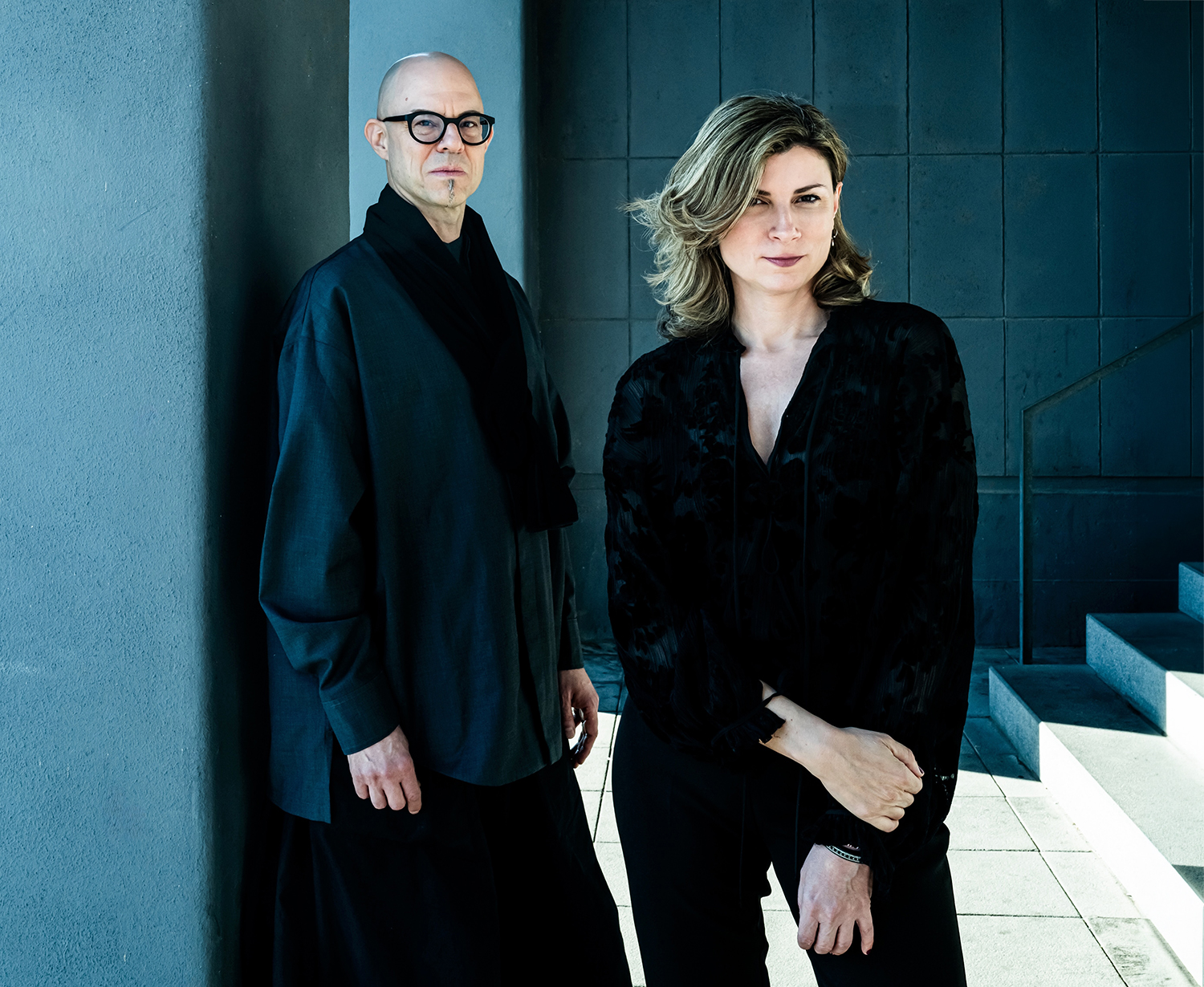 Photo: Annemone TaakeThe most intriguing creative relationships emerge when artists are secure enough in their own identities to embrace the possibilities of another’s vision. For pianists and composers Tania Giannouli and Nik Bärtsch, that confidence allows ideas to move freely between them, with neither confined to leading or following. Their debut album Metakosmos brings decades of distinctive musical exploration into a constantly evolving dialogue, as lyrical passages, interlocking rhythms, and moments of silence reshape the roles of two grand pianos. Together, the pair move between composition and improvisation, and precision and spontaneity, as they create music that feels both meticulously considered and open to surprise.
Giannouli has established herself as one of Greece’s most adventurous contemporary composers and improvisers, developing a body of work that seamlessly shifts between classical music, jazz, avant-garde experimentation, and traditional forms. Her recordings, including Forest Stories, Transcendence, Rewa, and In Fading Light, reveal a fertile musical imagination rooted in emotional directness and an affinity for melody. Whether working with her piano, trumpet, and oud trio or collaborating with musicians from widely different cultural backgrounds, she approaches composition as an open-ended process of discovery. Greek musical traditions inform her rhythmic and melodic sensibilities, but her work has consistently resisted geographic and stylistic boundaries, earning international recognition for its originality and expressive range.
Bärtsch has pursued an equally independent path, establishing an influential musical identity through his ensembles Ronin and Mobile, as well as solo performances and recordings. The Zurich-based pianist is best known for his concept of ritual groove music, which combines interlocking rhythmic patterns, cyclical structures, minimalist repetition, and carefully controlled development. His extensive catalog, including recordings such as Stoa, Holon, Continuum, and the solo piano album Entendre, reflects a fascination with the relationships between musical architecture, ritualistic motion, and collective intuition. Influenced by jazz, funk, rock, contemporary classical composition, and Japanese cultural and philosophical traditions, Bärtsch has created an approach in which repetition becomes a vehicle for transformation, with subtle changes capable of dramatically altering the character of a piece.
The partnership began at Germany’s Enjoy Jazz Festival in 2022 and gradually developed through performances across Europe. What initially seemed an intriguing pairing became something more substantial as the two musicians explored the expressive range of the two-piano format. Their contrasting sensibilities became a creative catalyst, challenging each to reconsider familiar approaches and discover new dimensions in the other’s ideas.
Rather than rush into the studio, Giannouli and Bärtsch allowed the music to evolve through live performance before recording Metakosmos in April 2025. The album reflects that period of discovery while retaining a sense of spontaneity. It captures a partnership that has developed its own character while remaining open to new directions, with a creative chemistry that promises an exciting future.
Musically, Metakosmos draws from a remarkable range of sources, including classical chamber music, jazz improvisation, Balkan folk rhythms, sacred music, and intricate percussive patterns associated with instruments such as the cimbalom. Giannouli’s lyrical inclinations intersect with Bärtsch’s precisely calibrated rhythmic vocabulary, but their roles are rarely fixed. Melodic figures generate forward momentum, repeating motifs acquire unexpected dimensions, and passages of unbridled intensity give way to moments of near-stillness.
Innerviews connected with Giannouli and Bärtsch on Zoom from their respective homes in Athens and Zurich. They explore the origins and evolution of their partnership, the process of developing Metakosmos, and the musical and philosophical ideas that connect their unique backgrounds and approaches.
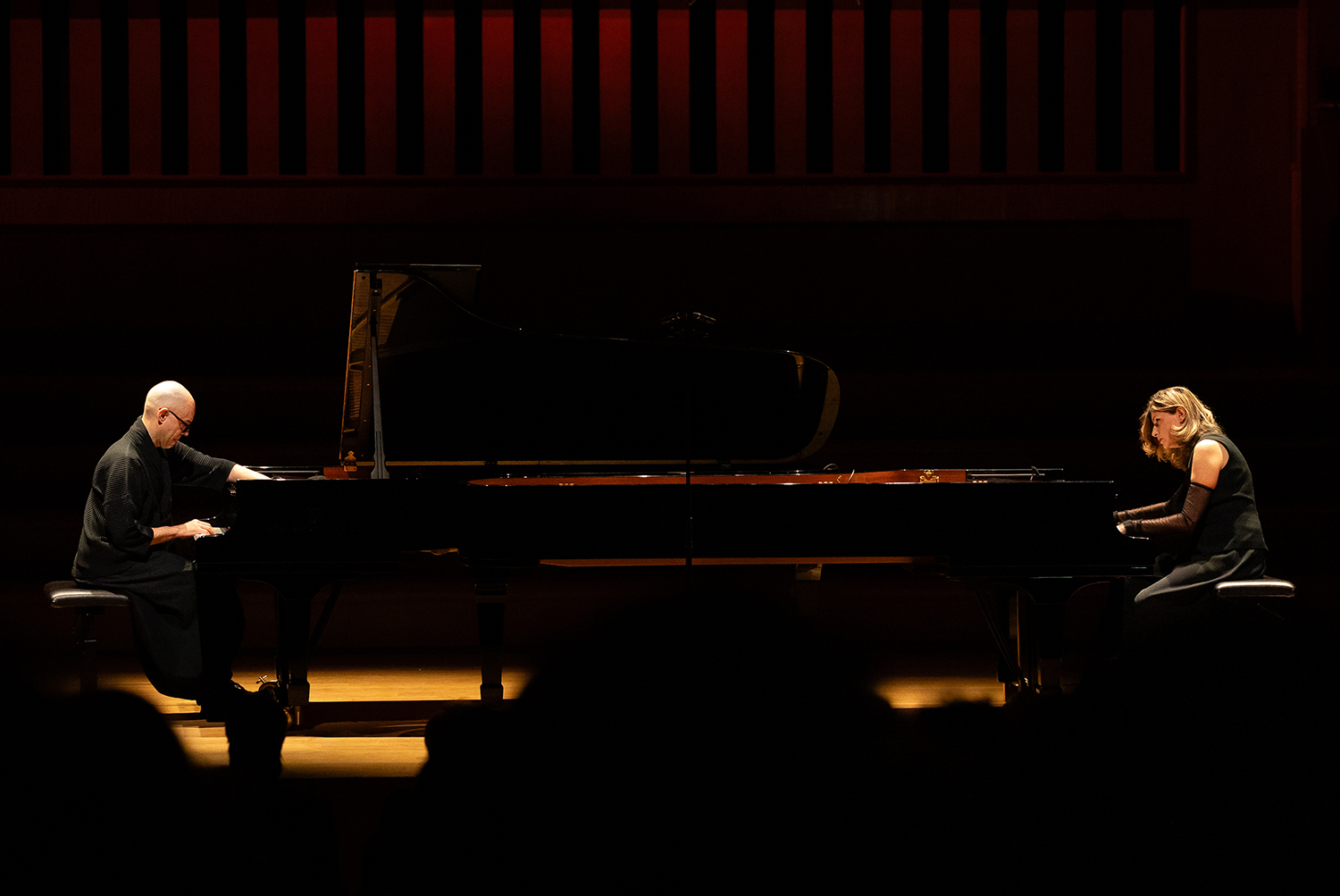 Photo: Geert Vandepoele
Tell me how this collaboration began and how it’s evolved in the three years you’ve worked together.
Giannouli: We were both artists in residence in 2022 at Enjoy Jazz Festival, a major German festival. Both of us were involved in different projects that year. I remember the moment I was in Kunsthalle Mannheim working on a new piece and had the thought that Nik would fit very well playing on it. I felt that because I had seen Nik playing solo live a year earlier. Although our musical languages are quite different, I felt we also had the same approach when it came to developing a concert.
So, I had the idea to work with Nik and I called Rainer Kern, the director of Enjoy Jazz Festival, and said, “Do you think we could do something together with Nik?” He suggested I ask him. Nik immediately said, “Yes, that would be interesting.” So, that’s how it started.
Bärtsch: We know a lot of interesting musicians are out there. Sometimes we have a chance to meet them, but rarely to play together. And when you do, you might just improvise a bit in the moment. But Tania and I decided to seriously dive into a collaboration. When I respect an artist and want to play with them, I invest time. And it can be complex with two pianos. You need a space, an occasion to present the work, and a good presenter as well. Enjoy Jazz Festival was such a presenter. Rainer Kern has been really important for our careers, supporting our development early on and inviting us to the festival regularly.
After making the decision to collaborate, we decided to perform the next year and present the result. But for this to happen, we had to practice.
There was an occasion to do so at Moods, a jazz club in Zurich, which is near my club Exil. Nicolas Stocker, the drummer from Mobile, was working at that time at Moods. They gave me the possibility to perform something I wanted to do. So, I invited Tania to Zurich and we started working. That was the beginning.
Giannouli: After we premiered the duo at Moods, we realized this was a very interesting and rare opportunity. The collaboration and building of the concert were very good for us, and we learned from the process.
Very often, there’s a lot of ego when musicians work together like this. They get concerned about who plays better, who has better technique, and whose compositions are going to be presented. But from the first moment we worked together, we realized that was not going to be the case. We both worked to make the music sound interesting and have impact and meaning. We felt that happened at the first concert at Moods.
Next, we decided this was something important and that we’d develop it further. We returned to Enjoy Jazz Festival in October 2023 to perform as a duo. We played in a very beautiful chamber music hall created by BASF, a big chemical company in the region. They have their own cultural organization and present their own programs. The concert was sold out and we got amazing feedback.
Rainer Kern told us he experienced the rare case of people sending many emails describing how wonderful the event was and how they wanted to have a recording. So, it was definitely a success.
We went on to perform in Athens, Helsinki, Poland, Brussels, and London at the wonderful Wigmore Hall.
Bärtsch: I have a classical background, which has influenced my music very deeply, although sometimes you don’t hear it on the surface when I play with my bands, or even solo. But in this combination, I found an interesting missing link. It’s rare to work with someone in improvised music who has experience in jazz and classical music, as Tania does. It’s also rare to find someone like Tania who has a good ear for groove music. Groove music can mean folk groove music or classical groove music, such as Stravinsky or Bartók.
Because of our shared background, we didn’t have to explain where a lot of the influences were coming from. We could also just dive into a groove and stay there. And that led to very interesting, beautiful, and strange results. It was about more than combining two people with similar interests or who were residents at a certain festival. What developed was something new that was really refreshing and interesting. It was also a chance to connect to a part of my life when I played more classical music in different piano-related bands and groups.
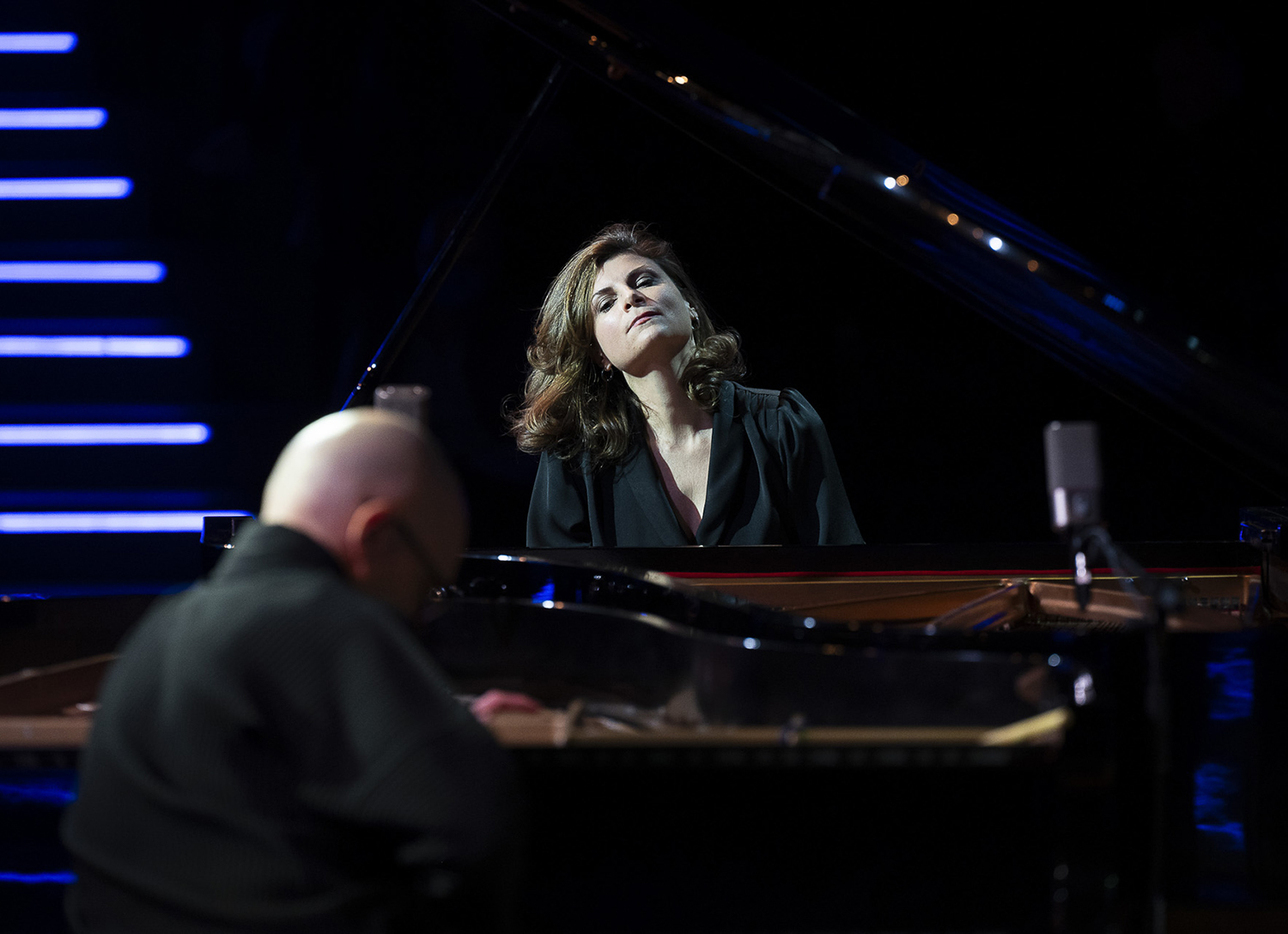 Photo: Vangelis Patsialos
Your collaboration began in the live performance arena. Discuss translating that into a studio recording and the possibilities that offered you.
Bärtsch: Development needs a lot of time, especially when you’re not just playing written music, but working on a dramaturgy together. As Tania said, after every concert, we were asked, “Where is your recording?” We were a little defensive because we were coming to this work with a fresh mind, and that’s not necessarily the moment when you record. The development is still occurring, and you need to have a few experiences, such as concerts, before you transform the collaboration into a studio recording. I found that taking time to collect experiences of working together was very important before recording.
We both love to rehearse and work on things. We’ll stay on an idea and go really deep into development. So, I think patience was necessary before making a recording. The Enjoy Jazz Festival and Rainer Kern were following our development and offered us an opportunity to make it happen.
Giannouli: Their contribution was really precious. They offered us the chamber hall for recording. It didn’t happen in a studio because it’s very difficult to find a recording studio with two equally great grand pianos. So, we recorded in the BASF Feierabendhaus in Ludwigshafen.
As far as the best timing for recording, it’s always very difficult to say. As Nik said, in the beginning, there’s a freshness and excitement, and you want to go further. Making an album quickly would have helped with visibility. But being patient and working on details as we did with each concert meant that maybe it took a while, but we did it in the right time frame.
The recording sessions were very smooth and natural. I wouldn’t say they were easy, but definitely relaxed. We didn’t do too many takes. We usually used first takes. In some cases, there was a second take, but we knew what we were doing and it went very well.
Bärtsch: A studio session is the next proof of an artistic relationship. I also experience this with my own bands. During every studio session, we’ve learned something about each other. We’ve also had a lot of conflicts. In one or two cases, conflicts led to a separation. That’s because the studio is a very honest, next-level meeting for an artistic relationship.
I agree with Tania that the session was focused, yet very relaxed. It wasn’t easy, but it was intense in a good sense. It’s what should happen in a studio. You outfox the knowledge you collected when you performed together, but now you hear things differently. A session is a totally different atmosphere from playing live. You can get close with the mics, and you can actually really hear what’s happening inside the pianos.
The recording also gave us confidence about where this collaboration can go. When you record, you’re usually a little too close to things. But with a certain distance, for instance, during the mix, we started to realize what we created as a duo, instead of through our individual playing. So, the result was very encouraging.
You’ve said you designed a new musical vocabulary for the album. Explore what that means and how it manifested itself.
Giannouli: Both of us have our own references and influences, some of which we share. As Nik said, I come from a classical music background. I studied piano and composition, as did Nik. Interestingly, we both studied something else apart from music at university. Nik studied philosophy and I studied agriculture.
We have some things in common, including ways of communicating. I’m not just talking about words, but how we react in a studio situation with our musical language. I’m more lyrical. I have a very big love for melody. I also have a part of me which is very avant-garde. I explore the sound possibilities of pianos, including doing things with the strings, especially at my solo concerts.
Nik has great experience and leadership in bands, grooves, and Zen funk. And in the end, the combination of what we do created the project. There are a lot of different elements that came together to create something unique.
Bärtsch: Studying Tania’s music opened up some ingredients for me that I don’t use so often in my own music. She mentioned lyrical and melodic development. I totally love that stuff, too. I listen to a lot of different music. In Tania’s music, I discovered a lot of things from different contexts, including melodies and rhythms influenced by Greek folk music. She also uses a lot of pattern accompaniment for different melodic organizations. There’s a lot of counterpoint. So, working with Tania provided a huge chance to dive a little bit more into those parts of the musical world.
At the same time, there’s a sharpness and clarity in my own style. To combine that fruitfully with another view was almost a way of proving my own musical capacity. Our approaches somehow seem different, but on the other hand, they are very close. It’s maybe closer than with some of the other people I play with, because Tania is educated in Eastern European folk music through her Greek background. I experienced that as a kid when I traveled to Greece and Romania. I love this music. I couldn’t play or copy it, because it’s not in my background or culture. But through classical music and my own development, hearing and feeling that from someone who is also experienced in improvised music was a huge opportunity. Tania is also experienced in combining these backgrounds. At first, I didn’t know how I would play over some of these ideas or what I would contribute, but it somehow came together.
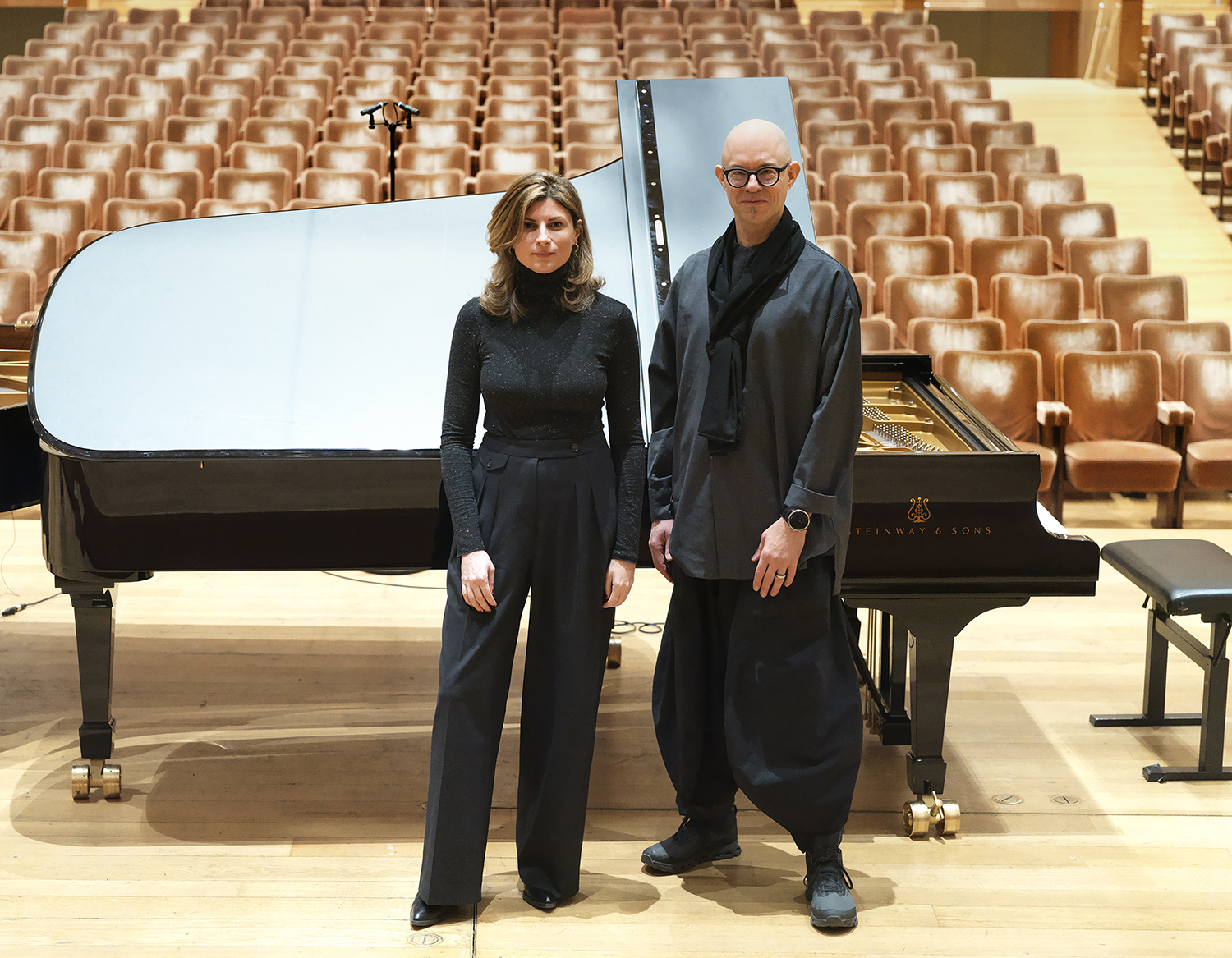 Photo: Savvas Lazaridis
The title Metakosmos suggests a reality existing beyond or alongside our familiar one. How was that concept present while creating the music?
Giannouli: We both believe in the power of music. We also make music not to please the audience, but because we see a spiritual aspect in the music. We ask ourselves, “Why are we doing this? What is the purpose of us as artists in this life?” I think we share many common views on this.
So, it was very natural to come up with this title. Meta and cosmos are both Greek words. We don’t have the letter C in the Greek alphabet, so we used K.
Also, we both started playing piano at a very early age. And one of the essential works for all young pianists to play is Bartók’s Mikrokosmos. So, we have a reference to Bartók on the album in a piece called “Bela’s Move.” We wanted to express our respect for him.
Bärtsch: Bartók had such a deep knowledge of classical music. He also respected and studied a lot of folk music. He even collected it and kind of preserved it for us today. Recently, when I read about him, I learned that a village he grew up in, in Romania, actually changed nations several times. In World War II, that part of Europe was part of Hungary. At the point when he came to the conservatory, Hungary had a nationalist movement to build up its own culture. But Bartók said the more he collected folk music from the Balkans, North Africa, and Persia, the more he realized the connections these folk musics have. They have nothing to do with nationalism. He believed there’s a kind of genetic code in music that brings people together and connects different ways of playing music. He believed there are interesting movements, spins, and patterns in every one of these folk music developments, and they are connected through history. Sometimes we cannot say why they are related, but they clearly are. And that’s actually the way Tania and I work together.
We have respect for our different backgrounds. At the same time, we respect freedom and our individual view on things, especially through improvisation. So, we can work on musical material in our own creative way, as long as we create togetherness through really listening to each other. If you listen carefully, your ideas will automatically change and adapt to fit.
One thing that’s interesting is that the listener can viscerally feel the physicality of your performances on the album.
Giannouli: Playing with Nik, apart from everything we’ve discussed, brings back a memory from my childhood. As a young piano student, every time I got the chance to play four hands with my piano teacher, I felt such joy. I had the thought, “How enormous can the piano be? And how many new melodies and colors can now appear?”
I have the same feeling every time I play with Nik. It’s pure joy and I think that’s obvious during our concerts. A lot of people comment about how we communicate, not just by listening to each other, but also by looking at each other.
Bärtsch: We play our backgrounds. It’s neither just a classical way of staying on the keys nor just improvisation. We work with subtle dynamics, and we go more into a joyful and sometimes eclectic way of playing. It’s a search for making the piano sound orchestral.
When you have two pianos, you have a way of being orchestral. We can prepare parts that are doubled. We can have many different counterpoint voices, instead of just bringing in chords. This is really interesting for me, because it’s different from when I play solo or with my band. With Tania, the groove can be on her instrument, while I play the counterpoints. So, it can be like having four players instead of two, with several voices.
The album also has a lot of space in it. Tell me about the philosophy of creating and maintaining space in what you do as a duo.
Giannouli: My main interest in all my projects is to create a really huge space in the right way. We both understand this and give each other a lot of space. It’s something we don’t need to discuss either, because it comes to us very naturally. I believe this element is very profound on the album.
Bärtsch: I think it’s perhaps the main reason why I’ve felt so comfortable in this duo. Usually, when I leave space, someone else fills it up. That’s the natural behavior when people play together. But when you meet someone who has enough patience to listen and leave space, that’s ideal. Of course, we also have very dense, vivid, and lively parts. But they’re all part of the dramaturgy for the whole album and the way we play.
In “Glass Labyrinth,” which is my favorite piece on the record, almost nothing is happening. It has a lot to do with Balkan folk traditions and Romanian music. There are parts where something repeats and you can improvise over it. That gives you total freedom, but you also want to keep what you do very simple in response. You’re able to reveal your virtuosity and create space at the same time.
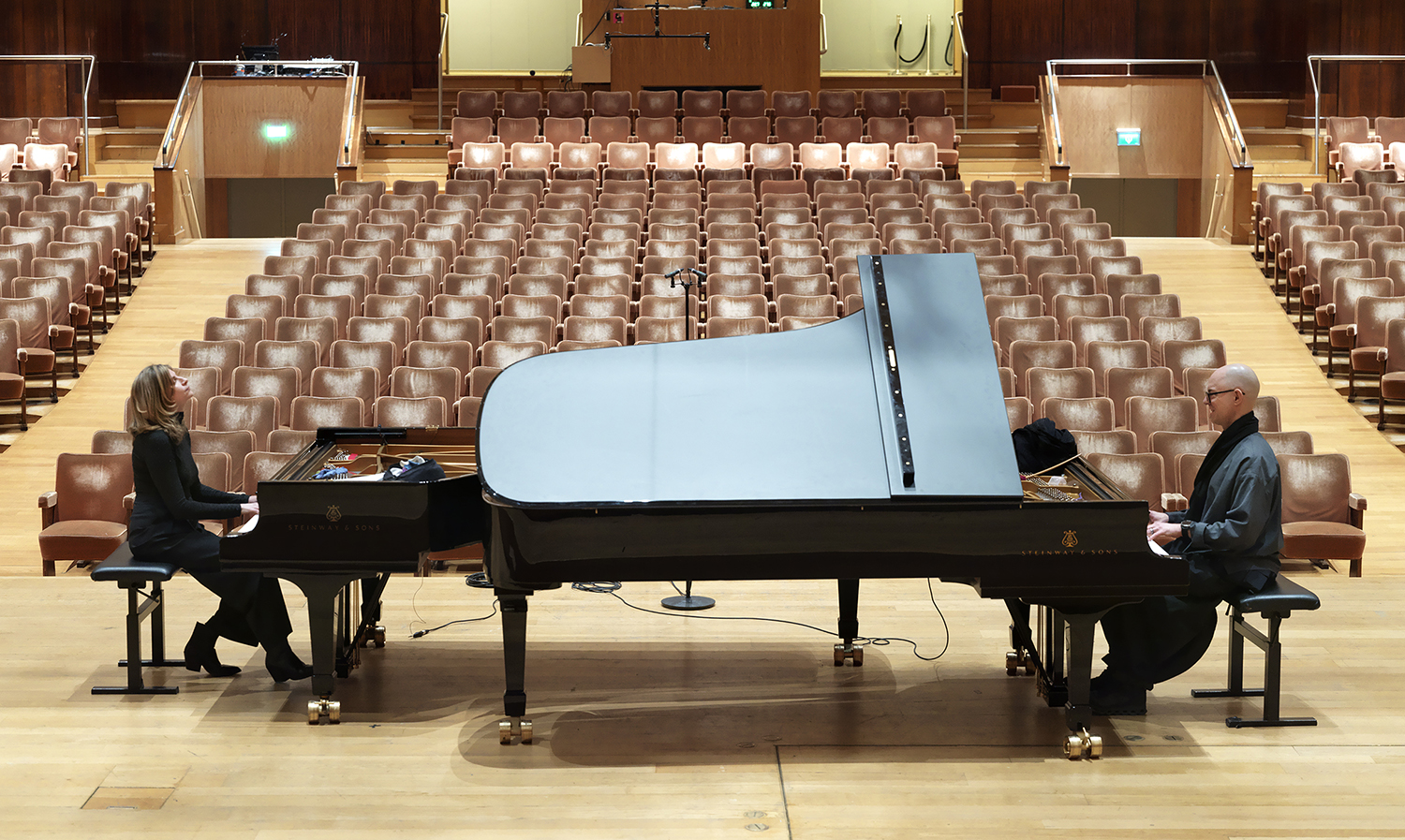 Photo: Savvas Lazaridis
“Then When” is a fascinating rhythmic exploration. There’s a lot going on in it. Tell me about putting it together.
Giannouli: It’s based on an original pattern from one of my earlier trio albums. But the way that Nik plays on it, and all the elements he added, are spectacular. When I listen back to the track, it feels like there are four percussionists, two pianists, and two bass players on it. But it’s just us. It’s one of my favorite pieces.
Bärtsch: I’ve never met anyone outside of my own bands who likes to play a pattern the whole time while keeping up the energy. Usually, when someone with a classical background does this, either it doesn’t groove or it starts to vary, because the person thinks it’s just a pattern. But we know from groove music that the pattern itself is the meaning, including how you play it and physically develop it with your presence across the piece.
This piece is the freshest in our repertoire. I’m still developing it. It’s really a challenge to find the right balance of space and development. I’m trying to bring in different approaches and dramaturgies to it that are really coherent, instead of just jamming over it.
There are other pieces in which one person is focusing on rhythm while the other is free to focus on melodic elements. “Spiral Spirit” is a fascinating example. Describe that split of duties and how you arrive at who does what at any particular moment.
Giannouli: Some things are already worked out, but at the concerts, there’s a lot that hasn’t been arranged or agreed on before. This provides an amazing feeling of surprise. It’s fascinating because I try to concentrate on what I’m playing, but I’m also hearing the new things Nik does, and I’ll immediately give him a sign to communicate “What you’re doing right now is amazing.” But I try to stay focused.
Our roles in this duo are changing all the time. Sometimes, I have many more groove-based things and Nik is focused on development. Sometimes, I’m focused on melodies and development, and commenting on groove things. It’s not fixed. We split the roles.
Bärtsch: “Spiral Spirit” has a really wild tribal drive. It’s perhaps the riskiest piece we play. It reflects the philosophy of Weather Report a bit, in that everybody solos, but nobody solos.
Sometimes when you open up a piece, you might have 20 ideas, but there might be only three major ones that create coherent dramaturgies. As Tania described, it’s important to listen. It’s like boxing or martial arts, in that you cannot stop. The music is happening, but the togetherness makes you pursue different lines. It’s super-inspiring, because I know the coherence is always there.
“Door 13/Pink Athens” is an extremely beautiful and evocative set of pieces. Tell me about its construction and what you’re communicating on it.
Bärtsch: This piece began with a very rigid setting, but Tania changed it into something almost like a Greek Orthodox chant or psalm. It felt modern, although it had archaic connections. It was a super-refreshing approach and opened up a way to present a different development and ending. I’m accompanying what happens in it, including the dynamics and phrasing. It’s a simple piece, but not simple-minded.
Giannouli: That’s the most difficult thing to achieve.
Tell me your thoughts on the future of this collaboration in terms of performances and further recordings.
Giannouli: We’ve started working on new material and definitely want to do a second album. We’re very excited about the new release. We hope we can play a lot, both in Europe and beyond, including Japan, other parts of Asia, the US, and Australia. We have big plans.
Bärtsch: This is a delicate thing because finding two reasonable pianos to play in a good setting is not so easy.
What we do is modern classical music that’s nourished by other traditions. It’s a missing link between improvised music, jazz, folk music, and classical music. It has an urgency and importance. It’s also absolutely joyful to play and develop. So, I think the record has an importance in piano history in terms of what you can do with the tradition of classical music and improvisation. This actually took place up to the beginning of the 20th century, and from time to time shows up again. We work with this tradition as composers, pianists, interpreters, and improvisers.
Given the fraught times we’re living in, do you feel an additional sense of purpose in spreading positivity and creating dialogues through your work together?
Giannouli: Absolutely. It’s so difficult to stay positive today. Both of us receive feedback from people who attend our concerts that the music moves them. Sometimes they even have tears as they thank you. When this happens, it’s such a wonderful thing. I believe all of us, in any aspect of this world, should be doing the best at what we are here to do. It’s something good for the world. That’s what I believe.
Bärtsch: I agree. We have the purpose to create quality. And this quality has an urgency. It’s also about the quality of your relationships, how you work together, how you respect each other, and how you create patience in learning to know one another. I think that’s the purpose of our work.
I think music is a nourishing force in our world that becomes more important in times like this. Music is the opposite of war. It’s also super-fragile. Every time you play a concert or make a record, you have to be aware of that fragile atmosphere and energy. Therefore, it’s extremely important to take it seriously and fight for it with your life.
Watch the video podcast version of the interview: