
Donate to Innerviews
Since 1994, Innerviews has provided uncompromising, in-depth interviews with musicians across every genre imaginable. And it does that with no trackers, cookies, clickbait, or advertising.
Your donations are welcome to help continue its mission of highlighting incredible music and artists, without any commercial considerations.
Your contributions will be instantly transformed into stories and videos, and cover hosting and web management costs. Importantly, your dollars will help ensure Innerviews remains absolutely free to all visitors, independent of their ability to financially support it.
Please consider making a donation today by using the PayPal QR code below.

Steve Hackett & Steve Rothery
Currents of Sound
by Anil Prasad
Copyright © 2026 Anil Prasad.
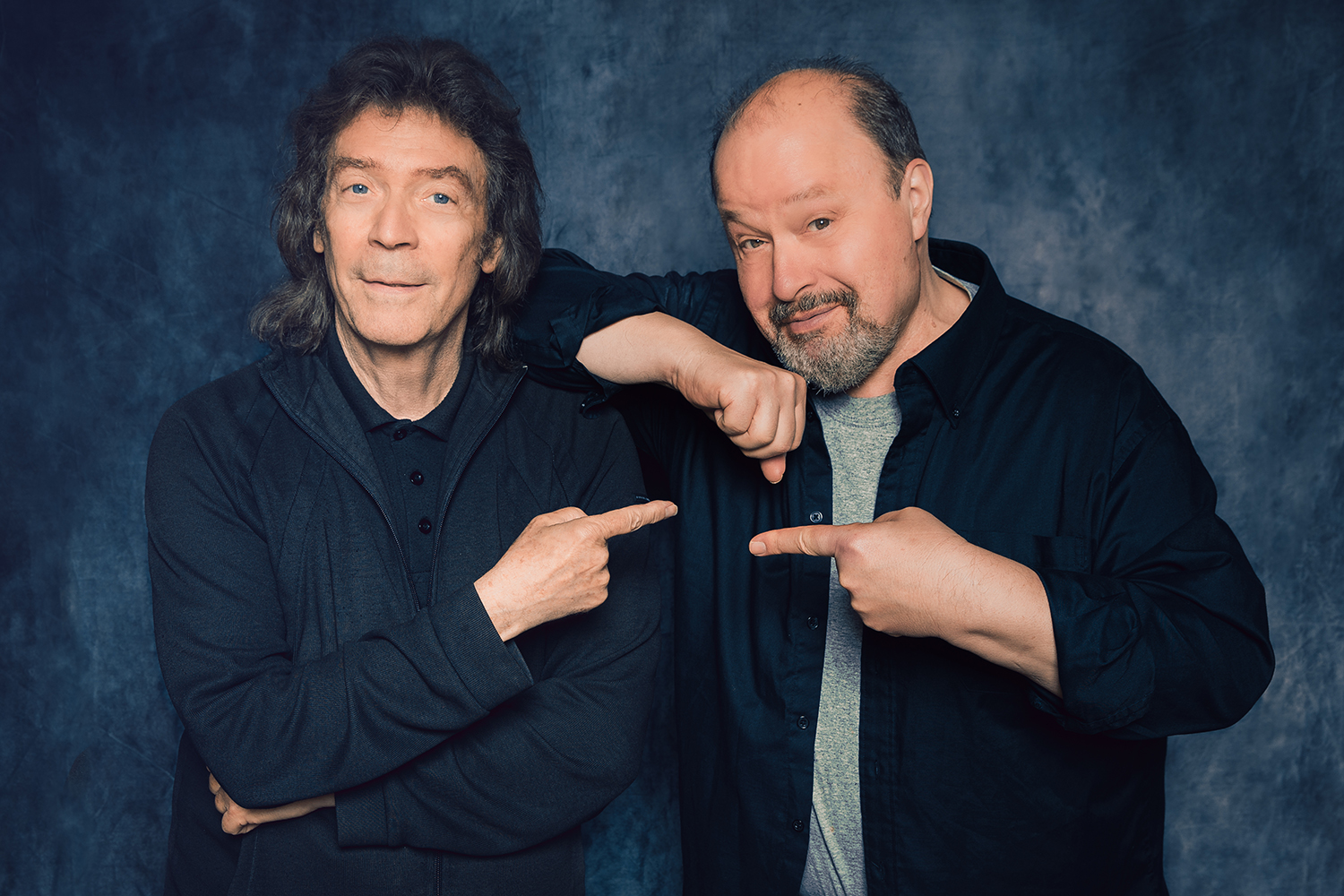 Steve Hackett and Steve Rothery | Photo: Anne-Marie ForkerSteve Hackett and Steve Rothery bring a natural sense of possibility to their debut collaborative album The Roaring Waves. Their guitars meet in compositions that are expansive without being overstated, melodic without becoming predictable, and richly atmospheric while retaining a strong sense of movement. The seven-track instrumental effort is also one shaped by curiosity, improvisation, and close musical interplay.
The sea provides much of its imagery and emotional center, reflected in the album’s immersive approach, lyrical guitar exchanges, and nuanced rhythmic underpinning. It’s a record that provides the musicians room to bring their individual voices to the conversation while creating something that belongs equally to them both.
The project gestated for nearly a decade, with touring and myriad commitments delaying its completion. Both have prolific output as solo artists, and Rothery remains a member of Marillion decades after first joining in 1979. When the two were finally able to spend sustained time on the music, their approach was refreshingly informal. Rather than arriving with every composition fully fleshed out, Hackett and Rothery spent time playing together, allowing ideas to develop through interaction.
Several of the album's most distinctive passages grew from those sessions, including “The Storm,” which began with a Hackett guitar figure before Rothery responded with melodic and textural ideas. Keyboardist Riccardo Romano further shaped the developing piece. That spirit runs throughout The Roaring Waves. The guitars aren’t locked into a conventional division of rhythm and lead, nor are they constantly pushing toward a climactic display of technique. They weave around one another, sometimes carrying the melody, sometimes creating moods and textures, and sometimes simply leaving space. The result has a cinematic quality that allows the individual pieces to breathe.
The connection between the two musicians goes back decades. Rothery was a Genesis fan as a teenager, absorbing Hackett's playing during his years with the band in the ‘70s. The two crossed paths several times in the ‘80s during studio visits and for charity performances and recordings. Rothery went on to perform on Hackett’s Genesis Revisited II from 2012, appearing on “The Lamia.” Hackett returned the favor by contributing to Rothery's The Ghosts of Pripyat in 2014. And Rothery joined Hackett in 2024 for "Fly on a Windshield" at The Royal Albert Hall to celebrate the 50th anniversary of Genesis’ The Lamb Lies Down on Broadway.
Innerviews had the rare opportunity to speak with Hackett and Rothery together over Zoom. The focus was on the here and now, centered on the experience of making the new record. They explore how particular pieces emerged, how their guitar approaches intersected, and how the project evolved over time. Just as revealing were the humorous exchanges and joyful camaraderie between them.
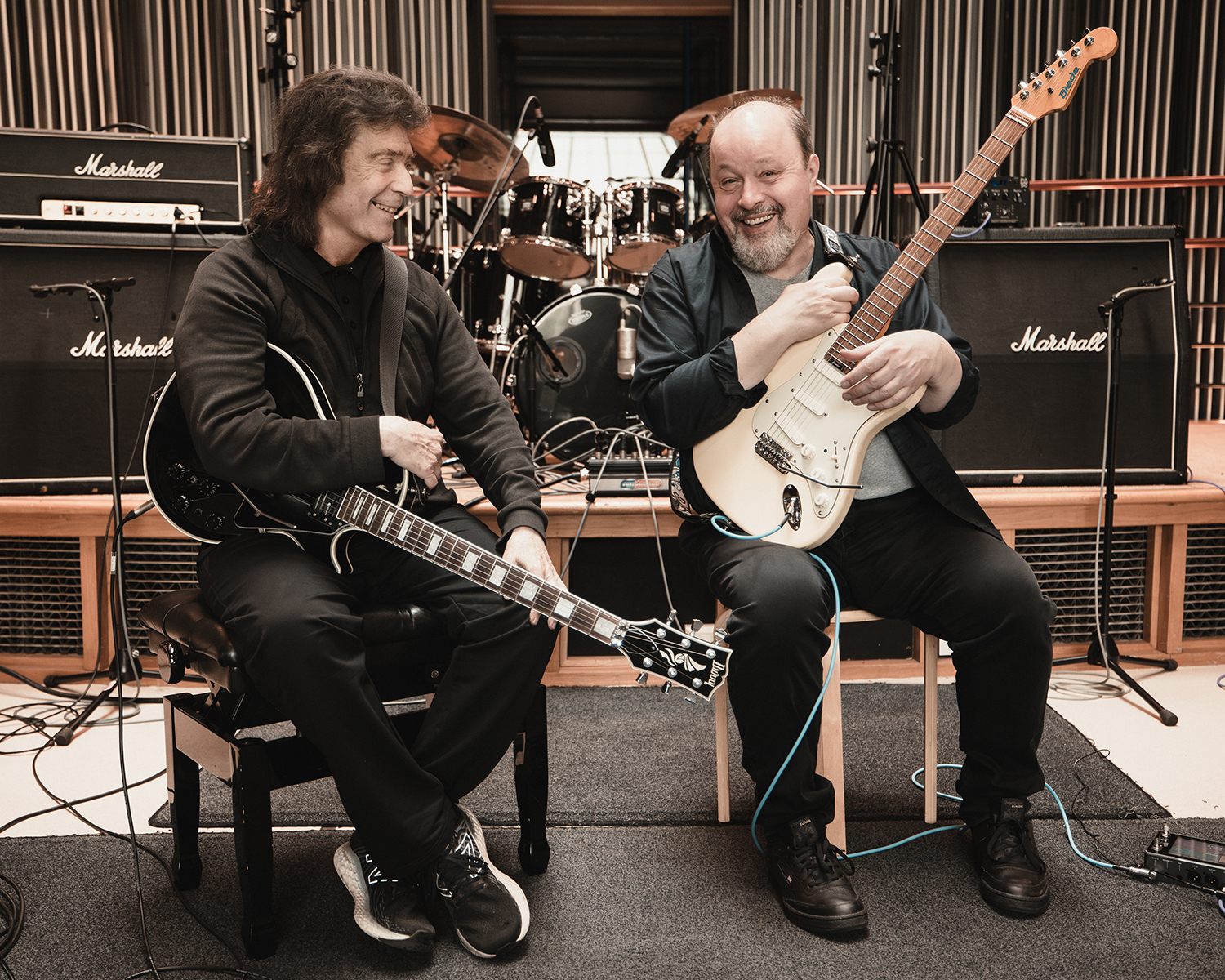 Photo: Anne-Marie Forker
You’ve known each other since 1983, but what spurred you to pursue this full-fledged collaboration?
Rothery: Money! [laughs] No, not at all. It’s as far away from that motivation as possible. I played on Steve’s Genesis Revisited II album in 2012 and then played live with him. He then played on my Ghosts of Pripyat album. We then started meeting up for dinner and talked about the possibility of doing something together, which eventually happened.
Hackett: I’ve done a few guitar pairing things before. First of all, there was Genesis with Mike Rutherford. He was normally playing 12-string guitar. I’d sometimes join him on a 12-string. And sometimes we had three 12-strings all chiming away at once, with Tony Banks also joining in on guitar. It sounded like a harpsichord ensemble at times. I’ve also done stuff with Steve Howe in GTR in the mid-‘80s, as well as the Feedback ’86 album that included Brian May.
What’s different about this is that there wasn’t an element of trying to make a dent in the charts. Rather, we were focusing on the music, without the need to pay back a massive advance to a record label from the word go. That’s a millstone around any self-respecting guitarist’s neck. This album was self-funded and self-motivated, and extremely selfish. We had a great time doing it, because we’re mates. We weren’t competing with each other. There was “No Shredding Required,” as Mr. Phil Collins might say. Eventually we involved a record company, which was Inside Out.
This album was about playing melodies we came up with spontaneously with each other. We wanted to make the kind of music that might make sense as a kind of film for the ear or a soundtrack.
Rothery: It was a musical adventure, created without any commercial considerations. It was done purely for the pleasure of us playing together. We enjoy each other’s company. And obviously, Steve is a huge influence on me as a 15-year-old growing up in Whitby, North Yorkshire. He’s one of the reasons I wanted to become a professional musician. It’s all his fault. [laughs]
It was a very relaxed, pleasant process involving two friends getting together and seeing if there was a creative spark. And there was, right from the first session. What you hear on the record is the result of that.
Hackett: We shared a lot of riffs and a love of Indian food. We went out a lot with our wives. Both of them are named Jo. So, Steve and Jo went out with Steve and Jo. [laughs] We always had a great time. Everyone got on very well with each other. Both our wives are also very creative people in their own right.
Expand on how your joint created process worked.
Rothery: It was written through improvisation, purely through the inspiration you get when you put two players together. It was informed by the idea of complete freedom and seeing where the path takes you. For instance, we’d be at Marillion's Racket Club studios, I’d fire up some drum loops, and we’d both just play along. Four of the seven main ideas came from those initial sessions. The other three came once we got the keyboard player Riccardo Romano involved.
It wasn’t an effortless process, because when you’re a musician and you try to create something, you have to give it supreme concentration and focus, so you can feel where the music wants to take you. But nevertheless, this wasn’t structured or planned in any way. It was born of inspiration.
Hackett: It was also born of conversation, rather than competition. We wanted to support each other and not be critical. There’s no point in doing that. Rather, we wanted to find out what each other’s strengths are and come up with a common language that fitted the two of us.
We visited Whitby, where Steve is from, for inspiration. We went there with our wives and stayed in a hotel. In the middle of the night, there was a storm. And that’s why there’s a track called “The Storm” on the record, as well as the other seafaring adventures represented on it. There are no lyrics on the album. It’s an instrumental album with evocative track titles.
Rothery: The track “Red Dragon” refers to the first ship of the East India Company’s clipper fleet in the early 1600s. It established the trade route with Asia for the spice trade. The instrument at the beginning of the track is a hurdy-gurdy, which predates that period by probably up to 150 years. It could quite well have been an instrument played on board the ship as it sailed the Indian Ocean.
Once we’d been to Whitby together, the common thread of nautical themes solidified in our minds. So, we also have “K-129” on the album, which refers to a mysterious Russian submarine that vanished off the coast of Hawaii in the late ‘60s. According to conspiracy theorists, it had a KGB crew that was planning to start a nuclear war between China and the United States. The story goes that the captain of the sub scuttled it rather than let it happen. Whether that’s true or not, I don’t know, but it’s a good story. It’s an example of a track being based on historical events and then we’ve created a movie in our head from it that we then tried to find the soundtrack for.
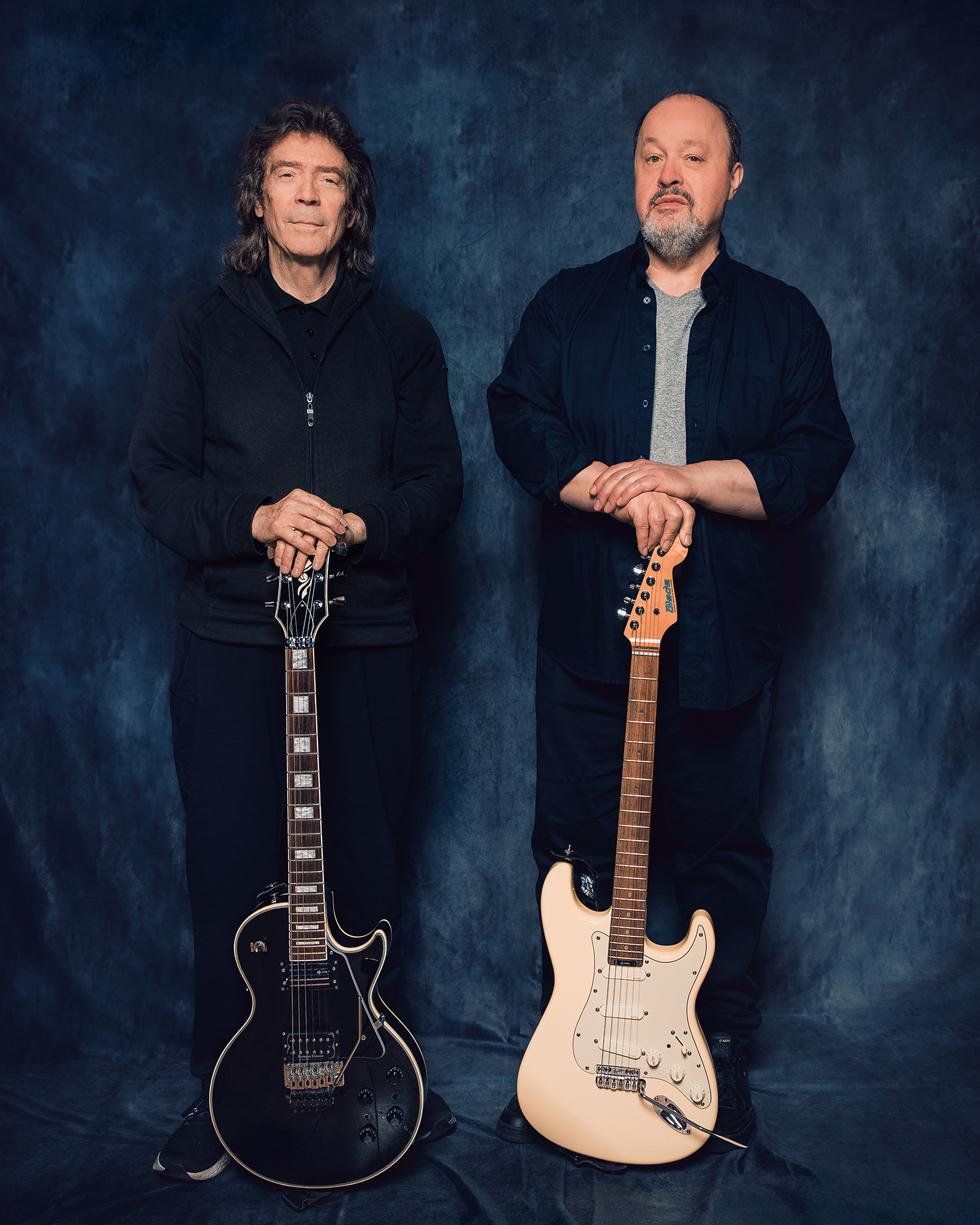 Photo: Anne-Marie Forker
The creative process stretched across a decade, in between the myriad projects you were both engaged in. How did that influence how the pieces came together?
Hackett: We were forced to take that much time because our schedules were crazy. The last 10 years have involved flat-out touring. Living in a suitcase means you can’t always make a collaborative recording happen. The same was true for Steve. He was also flat out on the road with Marillion and his own band.
What that did mean is there was plenty of time to refine our jams. Riccardo Romano, who plays in Steve’s solo band, also helped everything gel, once we brought him on board. We then had someone who could conjure backgrounds for us very quickly, on the fly. He helped us program drums which we later replaced with real drummers. Riccardo also played most of the bass on the album. I’ve never thought of myself as a bass player, but Steve did some bass playing on it, too.
We also created an album that was the perfect length for vinyl. Vinyl considerations seem to be paramount at the moment. The world is in thrall once again to the novelty of what vinyl offers up. So, we have to address that at this point in time. Previously, I was doing albums that were nearly 75 minutes long. Now, it’s like “Oh, hang on a minute, you don’t have to do music by the yard.” So, now it’s quality over quantity. I think that’s what we’ve pulled off.
Rothery: I think this is almost music for an audience from another era. There’s not that much decent music exposed in the mainstream these days. There’s nothing decent that gets played on most radio stations. You find out about interesting things on social media, YouTube, and word of mouth, really.
I think there has been a resurgence of interest in real instruments and physical product. I thought it was just going to die a death and that everything was going to be streaming, and that Spotify and Apple were just going to line their pockets, and all musicians would starve. But it seems to have turned a corner. We still have the threat of AI and generations growing up wanting to listen to nothing but what it creates. But I think there’s still a real taste for real music played by real musicians.
Hackett: I think listeners are buying into our personalities as well. Why go out and buy an album by either of us, when they could easily get a machine to create it. Today, you can just dial up something that sounds a little like your favorite band. We’re on the cusp of that brave new world. But for me, I want to read a book written by a real writer. I want to see a film acted by great performers. I enjoy live theater. And I want to hear real musicians who’ve honed their craft for the entirety of their working life. So, if you’ve got respect for that, listen to his album and see what you make of it.
It’s not a shredder’s convention. Nobody’s trying to outplay one another on it. We didn’t try to make something virtuosic. We just did music that appealed to us. It’s not about the sprint. It’s not proficiency-based music. It’s something else. It’s actually rather pure.
Rothery: It’s a musical conversation between great friends.
It feels like you tried to create something peaceful, meditative, and atmospheric. You’re both very socially conscious people. Was there an element of this music serving as a tonic for the times we live in?
Hackett: I think the subtext of music is to heal. We’re in very broken times. We’re in a vastly decoupling world. Who would have thought that war would be such a great growth industry once more? The old hippie in me just wants peace and love. I know music has the power to heal. I’m not just making this up. I’ve seen it happen. It’s great medicine. It also brings people together. It’s a great ambassador for peace. These are ideals I hold dear. It’s why we do what we do.
Why do we live out of suitcases and go everywhere, when we could sit at home comfortably? We don’t have to do this. Some people say, “Why don’t you retire at your age?” But performing is the air that we breathe. I think we’re going to be doing this until we drop. Hopefully not today or tomorrow.
Rothery: You’ve got another 15-20 years, I’d say Steve.
Hackett: I’ve got friends who have passed on. I have other friends saying to me, “I think I might last another five years.” I think, “What? Are you kidding? What if you stuck around another 50 years? Go entirely bionic.”[laughs]
Rothery: I can’t think of anything more worthwhile that you can do in your life than bring something of beauty into the world that brings joy to people in such troubled times.
The album has traditional British folk influences, which both of you have explored in your solo and band work. Discuss how you infused that interest into this album.
Hackett: The influence of acoustic music is always omnipresent with me. Whether I’m doing something that sounds Celtic, Tudor, Spanish, or Russian depends on how I tune the guitar. In my case, I’ve got a unique tuning I don’t believe anyone else uses in the world. I take the two bass strings down one tone, and then the B string goes down a semitone. It means everything you play on an acoustic guitar will be a complete surprise. It enables you to sound a little bit Russian or flamenco. It also means you aren’t going to fall into the usual cliches from regular tuning. So, there’s a side of me that likes to embrace the unknown in that way.
Rothery: Growing up in Whitby in the ‘70s, there used to be an annual folk week. There would be folk musicians performing on every street corner and in every pub. I think it was quite an influential thing on me growing up. I soaked up those moods, atmospheres, and musical vocabulary. Later on, I fell in love with the music of Joni Mitchell, especially her acoustic work and the open tunings she used. I loved how unusual her chord voicings were. I’ve tried to approximate that in standard tuning. I’ve also written some things in DADGAD. There are some really lovely ideas I hope we use on our next album together in that tuning.
Both of you have mentioned Whitby during our conversation. There’s a track called “Sandsend” on The Roaring Waves, which is the name of a fishing village in North Yorkshire, near Whitby. Tell me about the significance of that area, and why you wanted to capture the vibe in music.
Rothery: When we moved from South Yorkshire, where I was born, it was like a mining community. My grandfather was a miner. He died of Black Lung Disease. He was also a very keen musician who played the banjo. He was also a very keen photographer, which is my other passion.
We moved from there when I was about six, when my parents separated. We lived in a tiny little village called Newholm, which is about a mile and a half from Sandsend. It’s also a mile and a half to the sea. It was quite an idyllic place to grow up. It was quite isolated. There wasn’t even a bus service there, but it was still very beautiful, with the village duck pond and rolling fields. I used to walk through them with my friend, who was the son of the local farmer, to the beach and explore Sandsend. It had loads of interesting things about it. It used to have a railway line that ran across the coast. I used to walk through it when I was young and stupid. It’s a fascinating place. Part of it looks like Mars with all these shale rock kind of mountains around. All of that has always stayed with me. It was one of the first ideas I had when we started working together during our first session.
“The Black Sea” is a majestic and mercurial piece. What did you seek to capture and reflect on it?
Hackett: There was a chord sequence Steve had. As he was playing it, I said to him, “This sounds almost like film noir stuff. It sounds very soundtrack-y.” It wasn't a million miles away from John Barry’s spy movie music. Soundtracks are very important to both of us. Lalo Schifrin, Max Steiner, and Miklós Rózsa were also responsible for rather wonderful epic soundtracks.
The title “Black Sea” reflects the fact that it seems to be a troubled area. So, the music is deliberately murky and mysterious. We tried to interpret, musically, various aspects of water, whether it was the sea or fountains. Water is an endless source of inspiration.
“Black Sea” is one of my favorites. It’s almost kind of spooky. It implies that just around the corner, something is going to happen. Someone’s going to get assassinated like in one of those black and white film noir scenes.
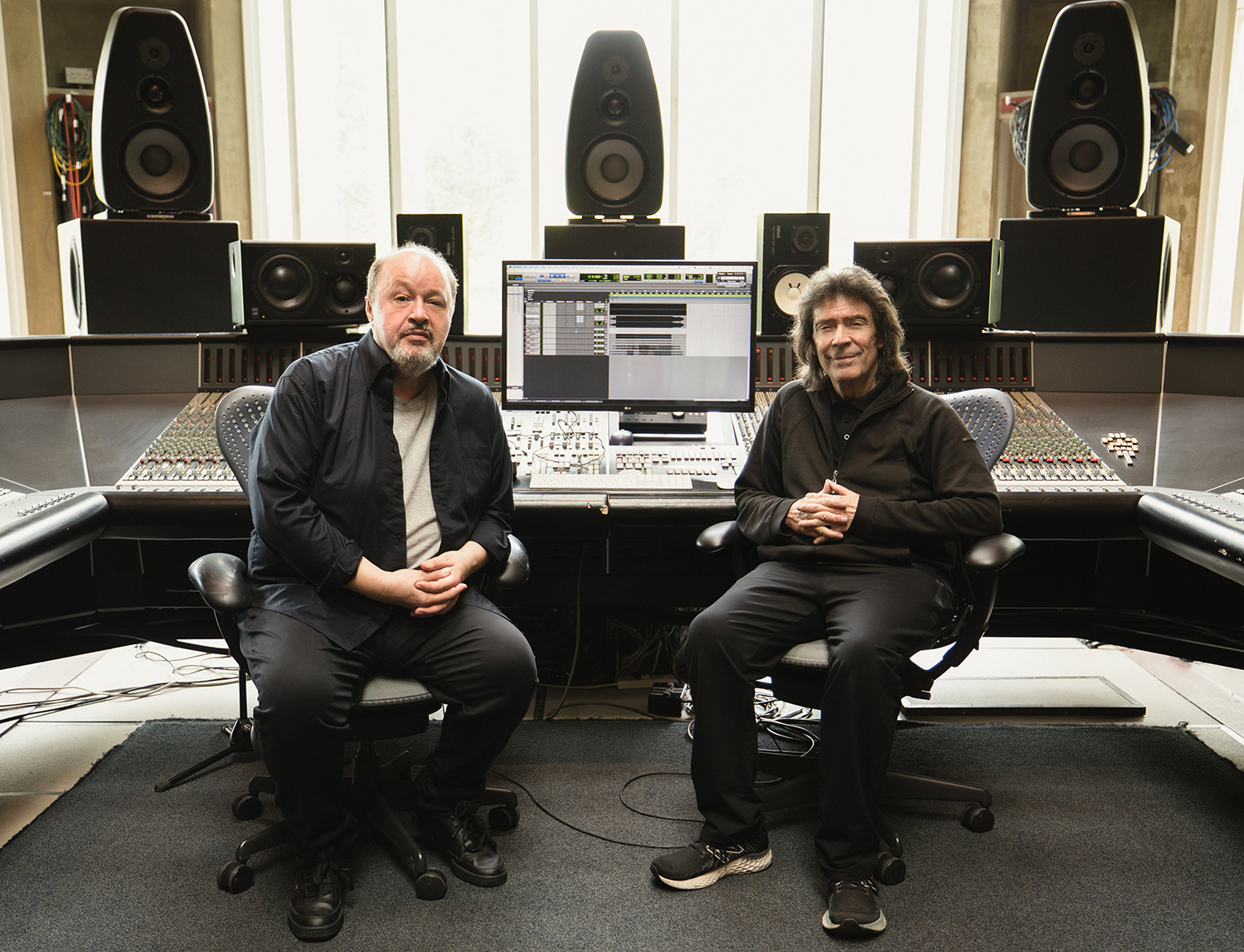 Photo: Anne-Marie Forker
Steve Hackett, you first encountered Steve Rothery when you visited Marillion at Marquee Studios in 1983, when it was recording Script for a Jester’s Tear. What spurred you to visit and engage with the band so early on?
Hackett: Ian Mosley had been playing live with me for a couple of years at that point and he’d just joined Marillion. So, it was very early days, but there was already a thread. The Marquee Club is also where I saw a lot of great music. I saw King Crimson there before they had recorded In the Court of the Crimson King in 1969.
Charisma, the outfit Genesis was signed to, had their offices just above the club. So, The Marquee was the center of the known universe. It was Mecca to us as young, budding players, with Charisma upstairs and the Marquee downstairs.
I was invited to visit these guys who were doing their first album in the back at Marquee Studios. So, I met everyone for the first time and made friends straightaway. I’d like to think I’m an open sort of guy. It was really great to watch their progress and then to see them do so well, firstly with Fish as their frontman, and then later with Steve Hogarth. They turned into a magnificent band and perform wonderful live shows. Plus, their guitarist isn’t bad either.
Rothery: I had seen Steve play the Reading Festival just after I joined Marillion in 1979. He had always been a huge influence on me growing up. Meeting Steve over the years has always been a great pleasure. We bumped into each other at various festivals and charity events over time. As Steve said, Ian had history playing with him, so it’s all part of an extended prog family. It was when I got asked to play on Genesis Revisited II that we started meeting regularly, and we became really good friends after that.
In 1986, both of you performed together as part of a Marillion performance for the Double O Charity at Hammersmith Odeon in London. You played “I Know What I Like,” which also featured Mike Oldfield. What do you recall about the event?
Rothery: I don’t remember much about it, really. It was pretty hectic on the day. Charity gigs are a different kind of thing and it’s always a bit of a blur. The musicians all want to do their bit to the best of their abilities, so it can be quite high pressure, I think.
Hackett: Roger Chapman was also on stage. He was from Family and had a fine voice, so there were lots of connections there.
In 1986, I also worked with Ian Mosley on my Feedback ’86 album, just after GTR. Pete Trewavas was on that record, too, along with Brian May, Chris Thompson, and the late, great Bonnie Tyler. They weren’t all necessarily in the room at the same time, but all those people were so very good at what they did.
During that period, if you were over 35, you were unlikely to get a record deal. I remember Nuno Bettencourt saying this to me, and that was after Extreme had a hit single with “More Than Words.” I had just worked with him and Gary Cherone in Japan for an event called Guitar Wars, together with John Paul Jones. I’m name-dropping like crazy, but this is a family tree. Once you open yourself to this kind of thing, you’ll find you’ll make friends everywhere. You’ll even meet the odd Beatle or Rolling Stone. It’s very rare I come across guys who are complete assholes, but there’s always time. [laughs]
Rothery: When have you hung out with a member of The Beatles?
Hackett: It was Paul McCartney. In 1994, I attended a charity art event Brian Eno had organized at Flowers Gallery for War Child in London’s East End. McCartney, David Bowie, and Kate Bush were there. I was introduced to McCartney. It’s very difficult when you get introduced to God. You hope he’s going to behave nicely towards you, and he did.
“Eleanor Rigby.” Need I say anymore? That’s it. The Beatles wrote the book. I don’t know of any British band worth their salt that hasn’t mentioned something from The Beatles as a huge influence. The fact that they wrote their own stuff and blazed the trail made it possible, I suspect, for the rest of us.
They started out as a singles act, but once they started making albums, it augured in an era of album-based acts. They were also the first band to have lyrics printed on the back of an album. I think Genesis came in on the coattails of the trail they had blazed. So, we owe them a debt.
Once The Beatles were finished, it was onto another era in the ‘70s. And then in the ‘80s, things became much more tightly controlled, with an emphasis on MTV-approved singles. But I think what we’ve done in the present day is have autonomy. We’re only doing the music we like. We’re not playing to anyone else’s tune here. We’re not trying to be on Top of the Pops. Who knows if our album will be taken to the bosom of the great American public or make any impression on Billboard or Cashbox?
Rothery: You roll the dice and see where they fall.
The Beatles were a huge influence on me. So much so, that 30 years ago, my uncle played me an early tape recording of me singing a Beatles song when I was three. It was a shock. I think it was early Beatles like “Help,” “Ticket to Ride” or “Can’t Buy Me Love.”
George Harrison is also a big influence on me. Even now, my slide playing owes more to him than probably anyone else in terms of playing melodies. On the new album, “Red Dragon” features my slide playing with a definite George influence. He was the master of playing just what the song required. I’ve always felt that’s my responsibility as a musician as well. It goes above and beyond my ego and desire to shine. The question is, “What does the song need?” That’s how you make the song complete.
Hackett: George always did the right thing for the song. He also did great stuff as a solo artist and with The Traveling Wilburys. He was also a great humanitarian. The Concert For Bangladesh preceded Live Aid. He made those sorts of events viable. Along the way, the four mop tops also managed to invent world music, it seems to me, by inviting in Indian musicians like Ali Akbar Khan and Ravi Shankar to work with them. It was multiculturalism and inclusive music. I prefer that term to progressive music.
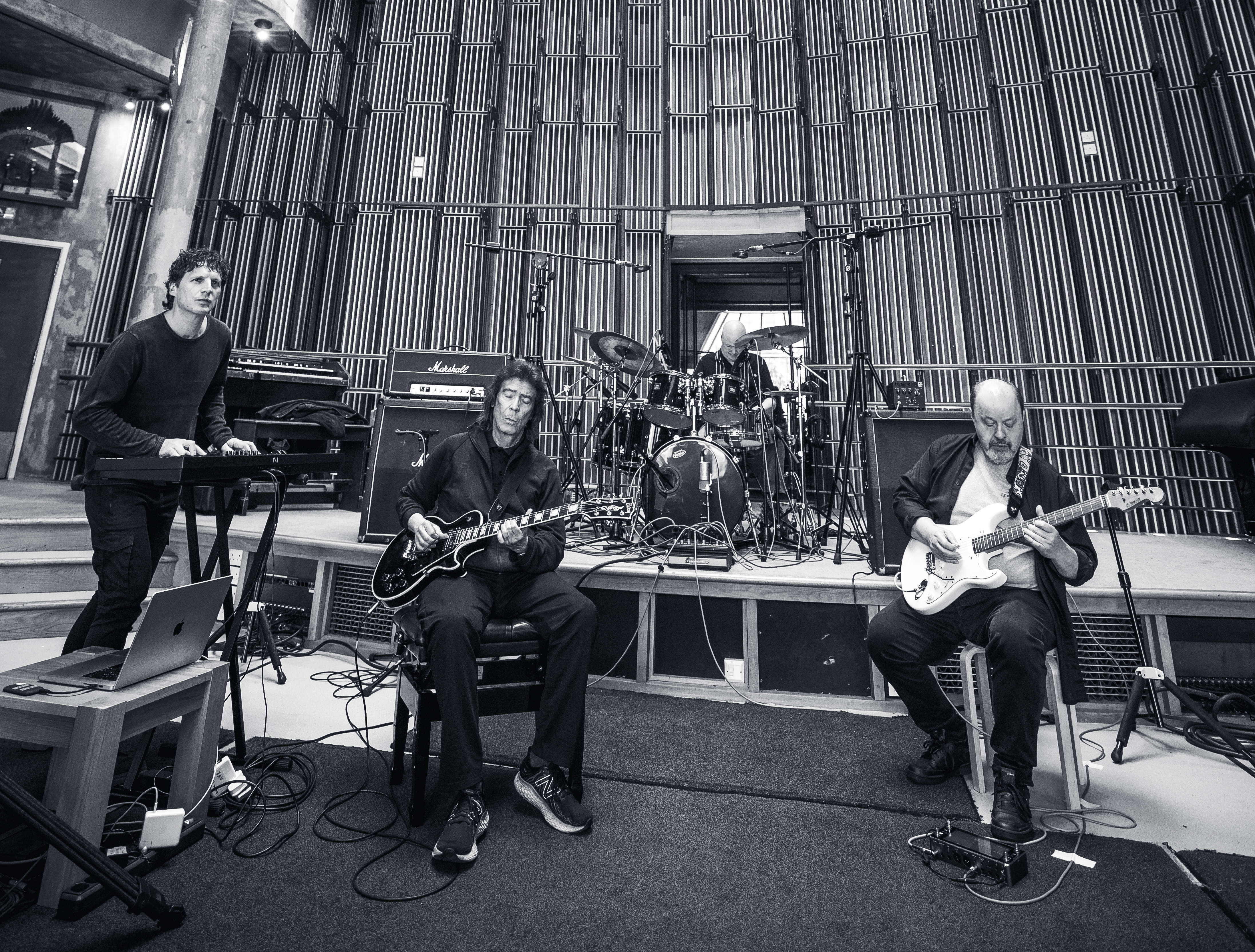 Riccardo Romano, Steve Hackett, Leon Parr, and Steve Rothery perform at Real World Studios, Wiltshire, England, 2026 | Photo: Anne-Marie Forker
You worked together on the 1990 Rock Against Repatriation charity single “Sailing,” spearheaded by Steve Hackett. It protested the forced repatriation of Vietnamese boat people in Hong Kong during that period. How do you look back on it and what are your thoughts on the relevance of the statement you made, today?
Hackett: For a year, I became a professional beggar, approaching all my friends in music, as well as people I didn’t know. I would ask anybody to take part. I wouldn’t take no for an answer. I became a real pain with this, but I was dedicated to the cause. I got very little sleep. I gave it everything I had at that time.
I don’t think it was as emotive an issue for people as it was with people starving somewhere, but I believed in it very much. It was a great trial for me. I think it was my hardest working year, but so little of it was visible work. I had to have balls of steel to go up to people I didn’t know and say, “Are you going to do this? Will you work on this? And if you’re saying no, why won’t you?”
If anyone wants to undertake any kind of charity work, I have to warn them, it really is the toughest gig. You’re outside of your comfort zone. You’ve got to be fearless to do it.
Rothery: I remember going down and filming with Steve and playing some guitar parts. It was a great experience and such a worthwhile thing to take part in. Raising money for worthy causes and shining a light on the injustices in the world are great things music can do. If you can use your position to support positive things in the world by contributing your time and energy, I think you have a responsibility to try and do something. All of us in Marillion have been very supportive of The Hope Flowers School in the West Bank. There are so many things in the world you wish you could help out, including the situation in Ukraine and Gaza.
Hackett: Marillion did a track called “Gaza” for its Sounds That Can’t Be Made album.
Rothery: All you can do is make people think about situations. Whether or not that has a long-term impact, it’s hard to say. But motivating people to reach into their pockets and contribute to a worthy cause has to be worth your time and energy.
Hackett: We see such horrors on television. If you channel surf a bit, you’ll come to Al Jazeera. It’s showing the underdog in so many situations. I’ve realized people are divided in terms of their political orientations. I’ve decided to do a couple of nights in 2027 at The London Palladium for Save the Children. There’s no political agenda involved. We’re there to deliver help where it’s needed. My wife and I have been engaging with the charity. And once again, I probably have to start calling people in the industry and tracking people down to see if they’d like to be involved. We’re seeing kids being arrested, tortured, and being torn apart from families. It breaks my fucking heart. The world needs to wake up, get in there, and bloody well do something. Don’t be apathetic about it. It should be beyond whatever religious beliefs you have. Rant over.
You’ve mentioned a potential second duo album. Where areas do you feel that record could explore and could that open the door to live performances?
Rothery: I can see different aspects explored on the next album. I can see some things that are a lot heavier in terms of riffs, vibes, and moods. I can also see something lighter with some acoustic instruments. Those are two aspects I can see bringing to the table. I’ve got some themes in my head, but we haven’t had time to go through them yet.
I can’t imagine it would be difficult to make a second album, given our chemistry and how much we enjoy working together. And if we have two albums, it will make it easier to play live, although there might be an opportunity to do that before then.
Hackett: Exactly. With two albums, we would have more to draw from. Perhaps we’d play the odd cover live, who knows? That would free things up and make it fun. We approached all of this work together with the idea of having fun. I do like the idea of doing something heavier. I’ve got a heavy riff brewing in my mind. We can’t wait another 10 years to do the next record.
Rothery: I’d like to think it would be no later than two years.
Hackett: If we leave it too long, we’re going to have the coffin dodger’s cull going on. [laughs] So, we have to work more quickly. I think we should amass the team and set aside a certain amount of time and say, “This is it. We’re gonna do it in this time frame.”
Rothery: I hope people enjoy the record. How it’s received will determine whether or not we get to play live. So far, the signs are good. “The Black Sea,” the first single on YouTube, has hundreds of thousands of views and loads of lovely comments. People can’t quite believe the two of us are working together and that the end result is something so magical. So, it would be a shame not to get ‘round to making a second album. This is too special not to do that.
Watch the video podcast version of the interview: