
Donate to Innerviews
Since 1994, Innerviews has provided uncompromising, in-depth interviews with musicians across every genre imaginable. And it does that with no trackers, cookies, clickbait, or advertising.
Your donations are welcome to help continue its mission of highlighting incredible music and artists, without any commercial considerations.
Your contributions will be instantly transformed into stories and videos, and cover hosting and web management costs. Importantly, your dollars will help ensure Innerviews remains absolutely free to all visitors, independent of their ability to financially support it.
Please consider making a donation today by using the PayPal QR code below.

Yosuke Inoue
The Inner Groove
by Anil Prasad
Copyright © 2026 Anil Prasad.
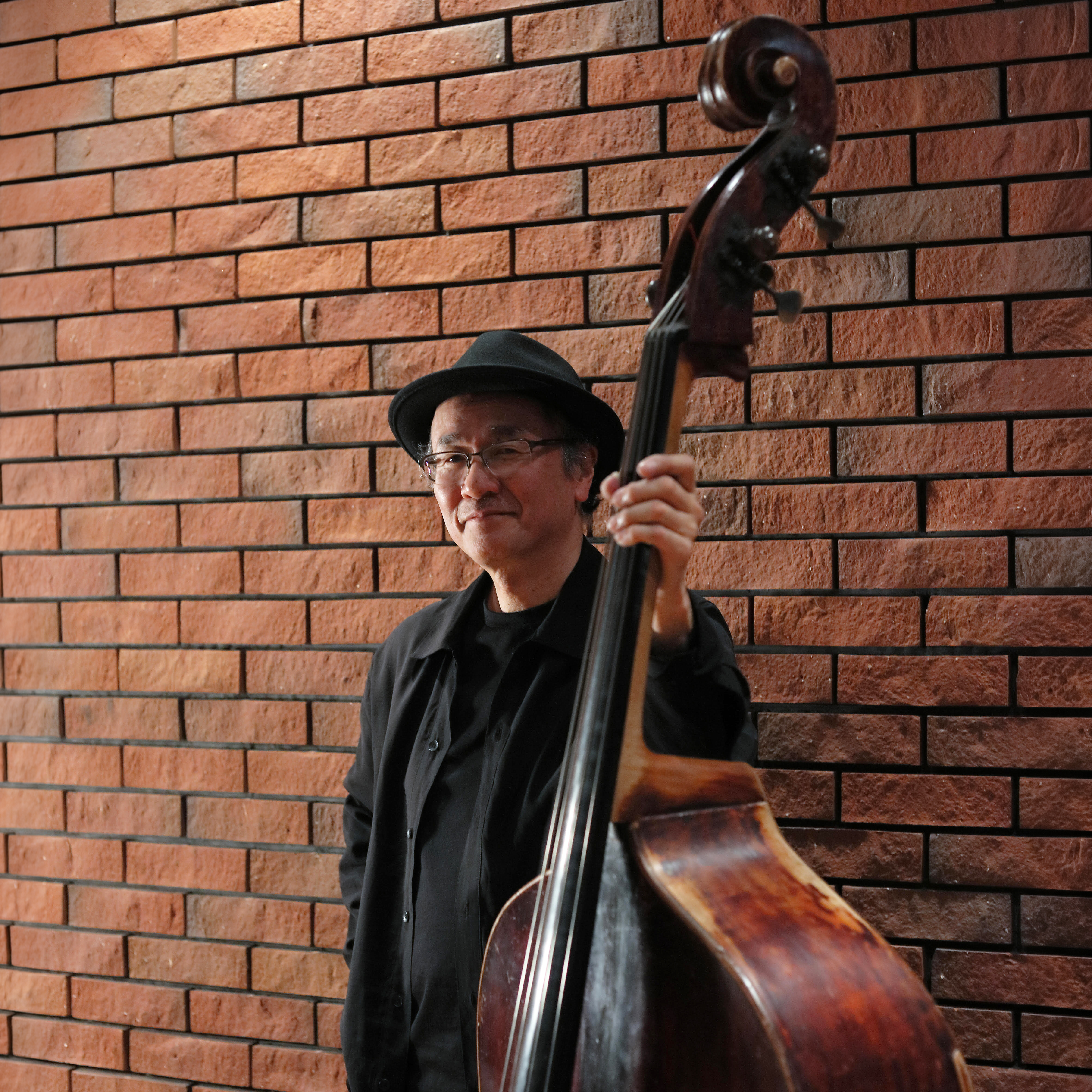 Photo: Shinichi TakahashiJazz has long celebrated virtuosity, but the musicians whose influence endures are often those who also understand how to shape the character of an ensemble as much as their own instrumental voice. Bassist Yosuke Inoue belongs firmly in that company. Over a career spanning more than four decades, he has become one of Japan's most respected improvisers, equally at home leading his own projects and contributing to the visions of others. His work alongside artists including Eddie Daniels, Roy Hargrove, Terumasa Hino, Motohiko Hino, Hank Jones, Carmen Lundy, Masahiko Sato, and Kazumi Watanabe reveals a musician whose adaptability never comes at the expense of a distinctive musical identity. Whether establishing the foundation of a swinging acoustic trio or navigating more exploratory terrain, Inoue brings an uncommon combination of clarity, imagination, and unwavering musical purpose.
That balance of confidence and consideration defines Who's Who, his latest recording. Built around a cast of five exceptional young pianists—Tadataka Unno, Shota Watanabe, Sora Ichikawa, Otohito Fuse, and Hatsune Hirakura—alongside drummer Ryutaro Goto, the album transforms familiar standards into living dialogues, with each trio configuration revealing a different shade of Inoue's musical personality.
Who’s Who follows two other compelling recent releases. Walking Alone is his first solo bass album, highlighting both the instrument's orchestral possibilities and the emotional honesty required to sustain an entire full-length album alone. In contrast, Time of Wonders, his duo effort with pianist Hideaki Hori, explores intimacy through interaction, demonstrating how two deeply sympathetic musicians can create the richness and spontaneity of a much larger ensemble.
The Yosuke Inoue Trio, featuring drummer Shogo Hamada and pianist Kazuhiro Takemoto, is another one of the clearest expressions of his artistic perspective. With a succession of recordings including New Stories, Next Step, and One Step Beyond: Live at Body & Soul, the group has become a vehicle for continual evolution. Each album expands the band's vocabulary while preserving the qualities that define Inoue's leadership: lyrical intelligence, rhythmic elasticity, and a commitment to listening as carefully as playing.
Beyond the jazz stage, Inoue is a sought-after contributor to anime productions, including Evangelion, Lupin the 3rd, Megalo Box, and Cowboy Bebop. Rather than approaching soundtrack work as a separate discipline, he embraces it as another form of narrative collaboration—one in which melody, pacing, and emotional nuance must serve the characters and story. His willingness to precisely support the intentions of composers and directors has made him an invaluable creative partner in projects where atmosphere can be every bit as important as technical brilliance.
When I met Inoue at the luxurious confines of Tokyo's New Otani Garden Lounge, he immediately projected the quiet confidence of someone entirely comfortable in his own skin. Dressed with understated elegance and carrying himself with relaxed assurance, he greeted me with a warm smile that quickly dissolved any sense of formality. Every answer seemed carefully considered, yet never rehearsed.
Our conversation ranged from the discipline required to sustain a decades-long career to his success balancing artistic integrity and constant evolution. We also discussed his experiences with jazz legends, the challenges of the ever-shifting music industry, the importance of nurturing future generations, and why, after so many accomplishments, curiosity remains his greatest creative fuel.
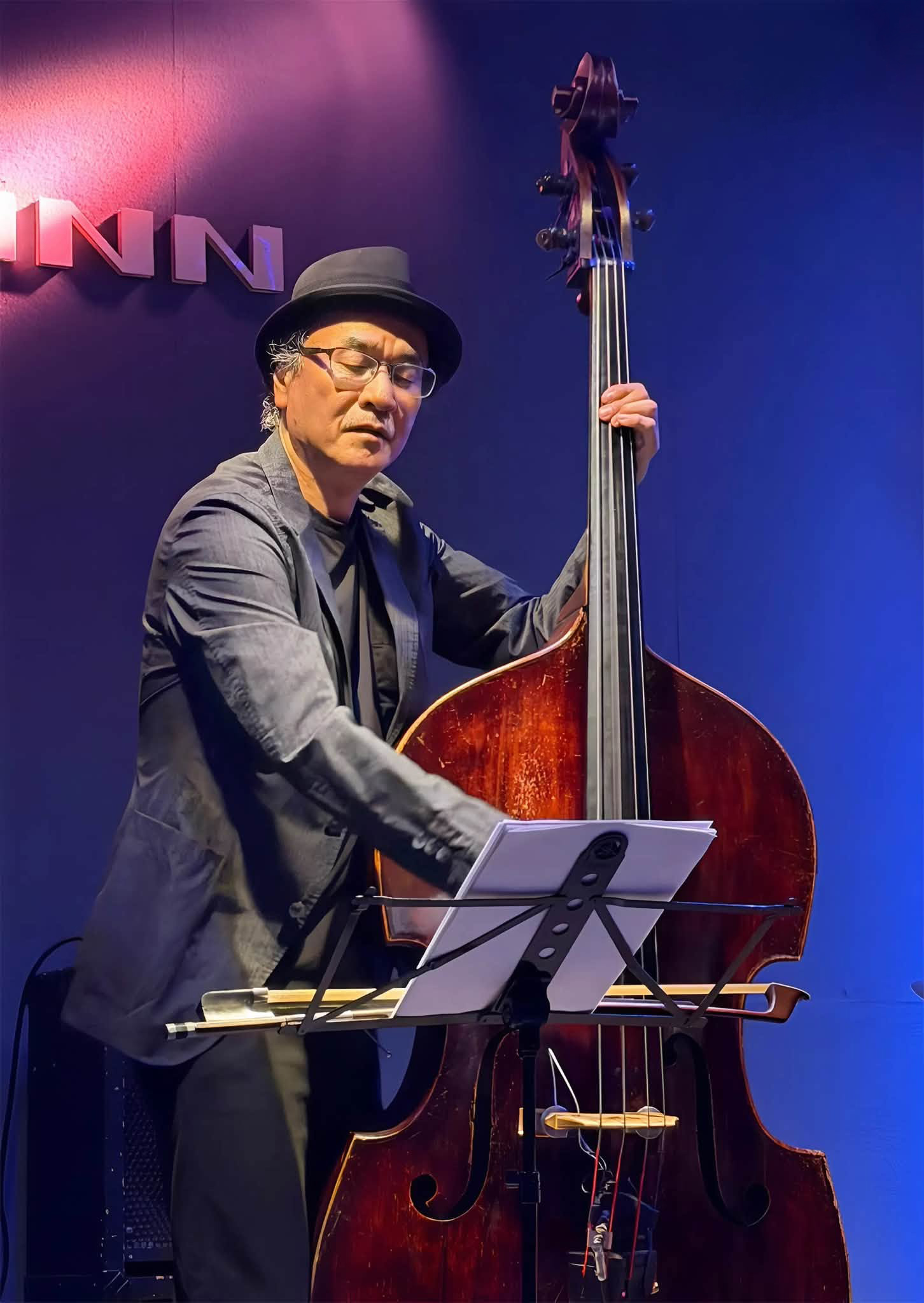 Yosuke Inoue performs at Shinjuku Pit Inn, Tokyo, 2026 | Photo: Anil Prasad
Tell me about the concept behind Who’s Who.
This is my thirteenth album as a leader. My last two albums featured my own trio. With my trio, I decided who the members were, what we played, and how we played the material. This time, the record was the idea of the producer Hiro Yamashita. It’s something he wanted to make happen for more than three years.
He wanted to have five different, young piano players play in duos with me. He wanted each pianist to have their own personality, so listeners could enjoy the differences as they performed with me and the drummer Ryutaro Goro. The idea was to capture how we might sound playing together at a small club.
One of the pianists, Tadataka Unno, is quite well known in America. He used to work with Roy Hargrove and Jimmy Cobb. In 2020, he was the victim of a terrible racist attack in New York City, where he was living at the time. He was badly injured. Thankfully, he recovered. He moved back to Japan, and it was great to have him on the album.
Mr. Yamashita also chose the album name and album design. I chose who played each tune. I wanted the pieces to really suit them. Mr. Yamashita worked for the Pony Canyon label for many years. He’s produced many albums for me. But he departed from the company, because Japan requires people to retire by age 60. But he really wanted to realize the idea of this album, so he made a special effort to be part of it and make it happen.
Who’s Who focuses on standards. What’s the key to bringing something new and fresh to them?
I find younger musicians tend to play their original material a lot more here in Japan. I understand that. I used to do that a lot. So, for them to play standards is a rare opportunity. They’re able to bring new ideas to them, including a different feel and tempos.
We wanted to capture spontaneity as well when making this album. We didn’t talk much or rehearse before we made the recordings. We just went into the studio, had a quick discussion about what sort of feel we would explore, and then we went ahead and played.
What’s great is that I can hear how each pianist brings their own approach and philosophy to the music. I think you can hear how they think about music and life through their performances. I think interpreting standards can be a very powerful thing for revealing these things.
We did two takes of each tune, but I mostly used first takes. The first take is always where the magic happens. The second take is a backup in case something goes wrong with the recording process, like a computer problem. But none of that happened when we made the record.
I always prefer the first take, even if a couple of notes are shaky. It doesn’t matter to me as long as the music is good. Miles Davis played many strange notes during his recordings, and I think most of the great jazz albums aren’t about being perfect. So, I don’t mind having some mystery on my records.
How well does the jazz scene in Japan support young, up-and-coming musicians?
Some important clubs like Body & Soul in Tokyo are closing. It’s happening because the economy is pretty bad. Also, the owner of Body & Soul, Kyoko Seki, is now 85 and she wanted to retire.
So, while there are fewer big clubs with opportunities for younger players, there are now many small clubs emerging. I’m talking about venues that hold 20 people. A lot of young musicians play in those places. The rooms are very tiny, but the clubs are very supportive and run by people dedicated to the music.
Some of the younger musicians have another job. They know it’s hard to feed themselves just as a musician during this era. For instance, Otohito Fuse, who plays on Who’s Who, is also a computer programmer. He graduated from Tokyo University, one the most important universities in the country. He’s such a talented piano player, but he also doesn’t want to worry about the financial part of his life. So, he has the freedom to play whatever he wants because of that.
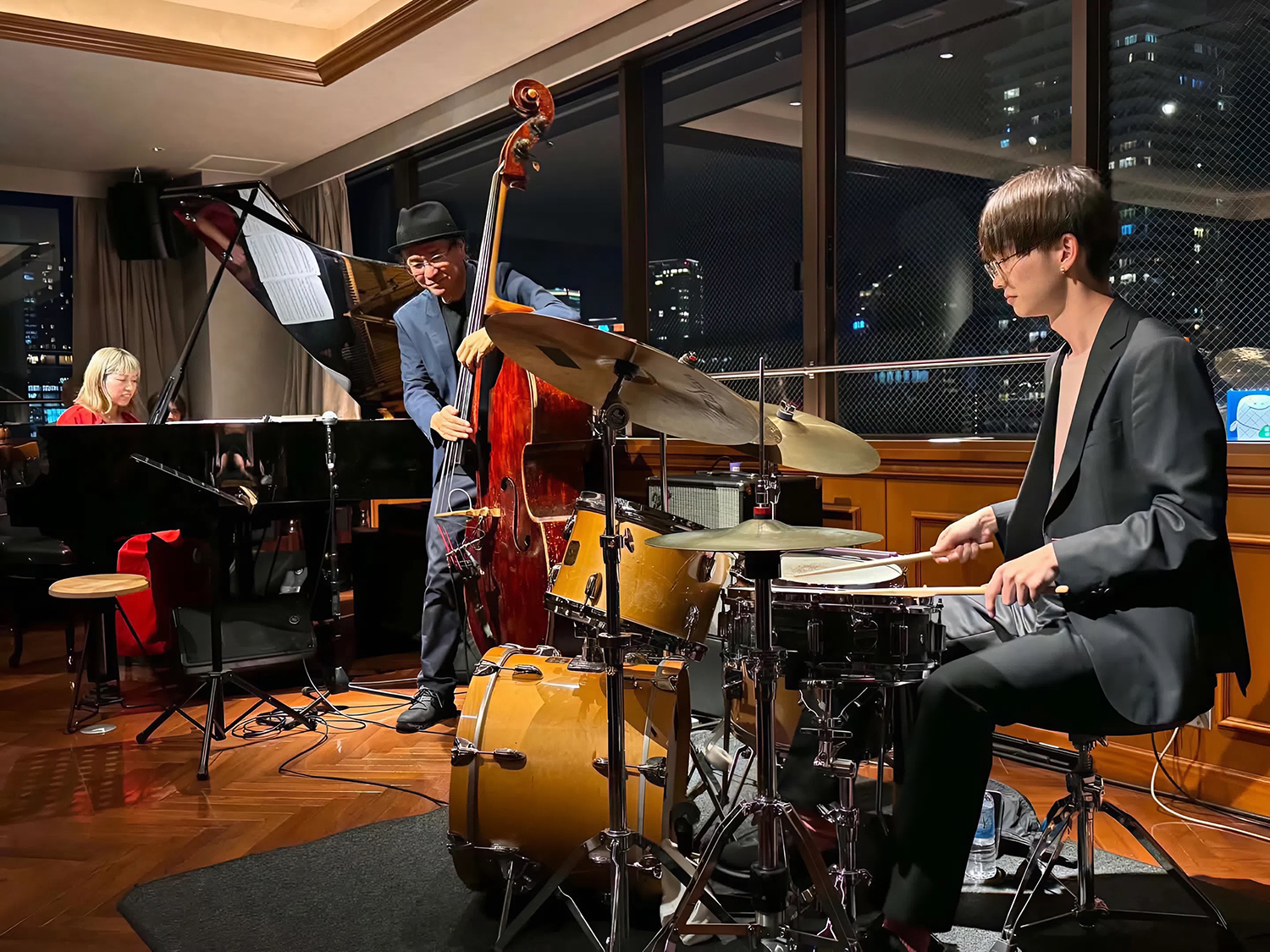 Hatsune Hirakura, Yosuke Inoue, and Goto Ryutaro perform during the Who's Who tour at The Royal Horse, Osaka, 2026 | Photo: Yosuke Inoue Collection
Your last release was the solo bass album Walking Alone. Tell me about approaching standards in this way.
Solo bass is a hard thing to present when you’re handling the melody, harmony, and rhythm. I thought it was best for people to at least know the tunes, so they could understand solo bass within those contexts.
It was a challenging process to work on and put together. I worked really hard. I took a year to practice, prepare, and make the album. I used some different techniques, including ideas inspired by guitarists. Sometimes, I’d be using my fingers to play harmony and harmonics, while I’d use my thumb to play the bass line.
I focus mostly on songs I know well from across the worlds of jazz, rock, and pop. You’ll hear music from people like Miles Davis, John Coltrane, Charlie Parker, John Lennon, and Steve Wonder.
I also play Bach’s “Cello Suite No. 1 Prelude” on it. I used the same key as a cello for it and included an improvisation section in it. Mixing the original composition with improvisation was one of the biggest challenges of my musical life.
How have you evolved as a bassist over the decades?
I really practiced hard when I was in my twenties. I started playing acoustic bass at 18 and then I switched to electric and then back to acoustic bass. I moved to New York City in 1991, where I explored a lot of different areas. By the time I was 40, I felt I had explored enough and moved back to Japan in 2004.
When I got back to Japan, I initially didn’t have many gigs, because I was kind of new to the Japanese jazz scene after being away for so long. So, I had lots of time to practice again. I found more possibilities on the instrument and reinvented how I did things.
I really worked on nailing intonation by using pizzicato. I found that to be a different way of approaching things. I’d set the pizzicato a little bit higher so I would really have to think about it.
In general, I also feel my bass playing became more natural, like speaking with a voice. Prior to age 40, I could play much stronger, like an athlete engaging in sports. But now, I can play more like I’m singing. That’s a big difference.
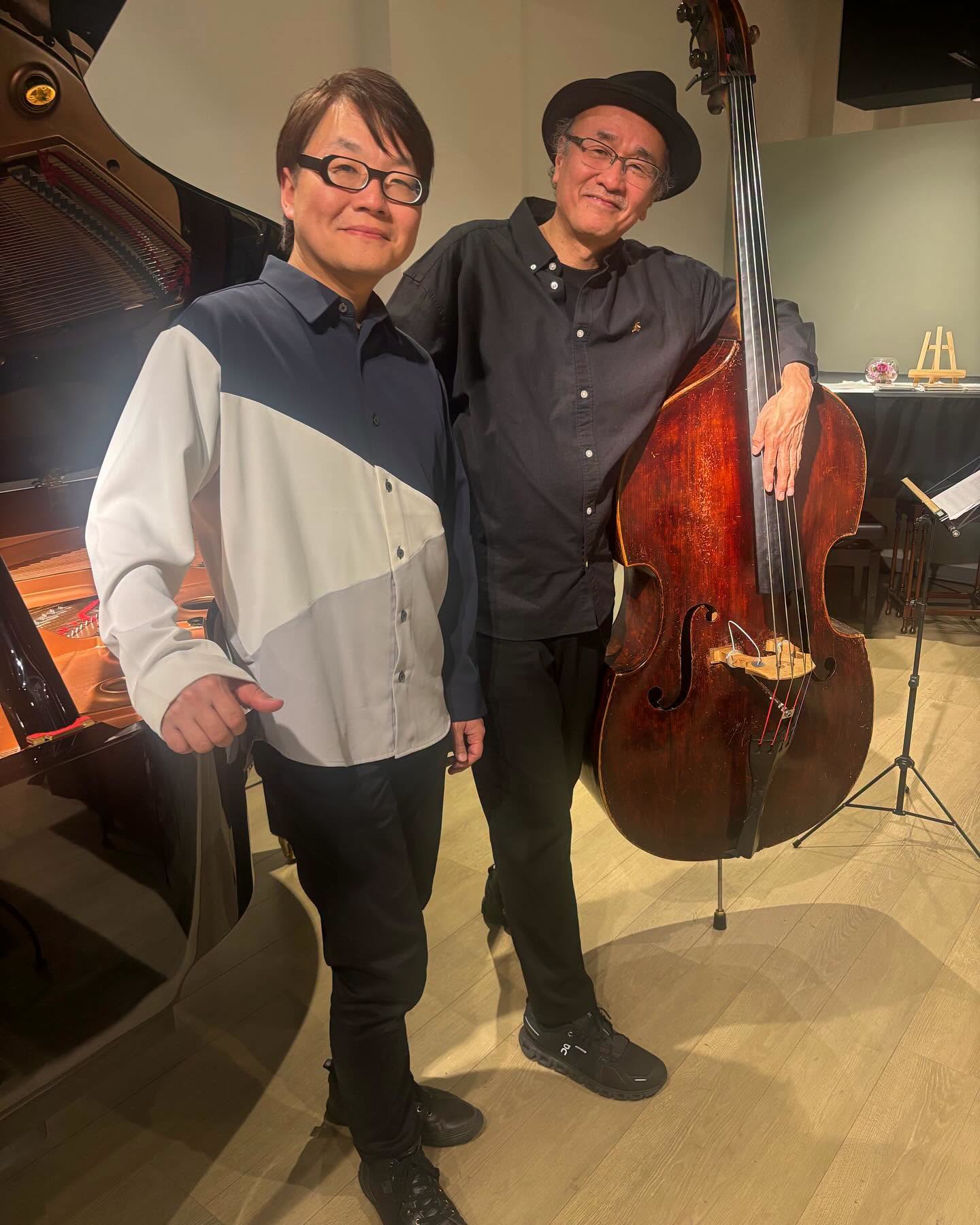 Hideaki Hori and Yosuke Inoue | Photo: Yosuke Inoue Collection
Another recent album of yours is Time of Wonders with Hideaki Hori. Tell me about that partnership and what makes it special for you.
He’s much younger than me but is really into jazz from the ‘90s. That was the era during which I was in New York City. When we first played together, I thought, “Wow, this guy really knows a lot about the ‘90s and has a real feel for the music.” I’m talking about artists like Mulgrew Miller and Kenny Kirkland. It’s rare to find someone who appreciates that period. He also has followed my music since the ‘90s.
We instantly had a great chemistry. And because he’s so young, he brought a lot of ideas into the music that I wouldn’t have considered. The duos we play on our album are very different from the ones on Who’s Who. It feels very unique and fresh.
Time of Wonders has a mercurial composition from you titled “Turn This Around.” Tell me about the piece.
I wrote that tune in 2020, right after the COVID-19 pandemic. It’s about moving on from it. We didn’t have any places to play, because everything was closed down. So, I stayed at home and wrote original music to perform on bass and piano.
The piece reflects the ‘90s sound and it’s influenced by Mulgrew Miller. The harmony is really complex, but Hideaki understood how it should work and said “Yeah, let’s play that.” He performed it as well as I could have hoped.
You’ve recorded a handful of your own compositions. Have you considered doing a whole album of original material?
I always write one or two for albums, but I haven’t done more than that. But I do like writing. My originals are kind of my main thing, but I’ve also recorded many standards as we’ve discussed.
My goal is to not sound different when I play an original piece or a standard. Many people sound different when they do one or the other. The Miles Davis Quintet was a great example of a band that could play originals and standards but sound like the same band.
Mulgrew Miller is one of my heroes in this regard. He really knows how to express his own identity when he plays standards. I think that should be the philosophy of every jazz musician. We should be able to play anything, but have it reflect your own identity. That’s why I like combining originals and standards on my albums.
You’ve gigged and recorded a lot with your own trio in recent years. What evolution do you feel has occurred with the group?
They’re very young and have evolved significantly. Kazuhiro Takemoto and Shogo Hamada have been like sponges, absorbing everything we’ve done together. They’ve both developed their own thing. They were great from the beginning, but I feel the musicians are now on a higher level.
In just three years together, they can now play anything and move in any direction. It’s why the trio has lasted so long. But they’re now so busy with their own projects and so in demand that it’s hard to schedule performances.
I understand that’s one of your key goals—helping younger musicians establish their own careers.
That’s true. I think I succeeded with that. It’s definitely their turn, but I’m very happy to play with them when we can.
It’s almost 30 years since your first solo album Speak Up. How do you look back at that album, made entirely with American musicians?
I was 32 when I recorded it. I was still fairly new on the New York City jazz scene, but I had started establishing myself and knew lots of people. I was six years into that experience.
It felt like it was time to record my own album, so I decided to record with the musicians I was working with at the time, including Matt Wilson on drums, George Colligan on piano, and Sam Newsome and Joel Frahm on saxophones.
I didn’t want to have a special guest, like a famous jazz star, on there. People are always doing that to sell a few more copies and get attention. I wanted to do something different that reflected what I was about and was focused on my own vision. It’s straight-ahead jazz, but I brought a lot of interesting ideas to it. I think it was a very strong statement and I'm very happy with that record.
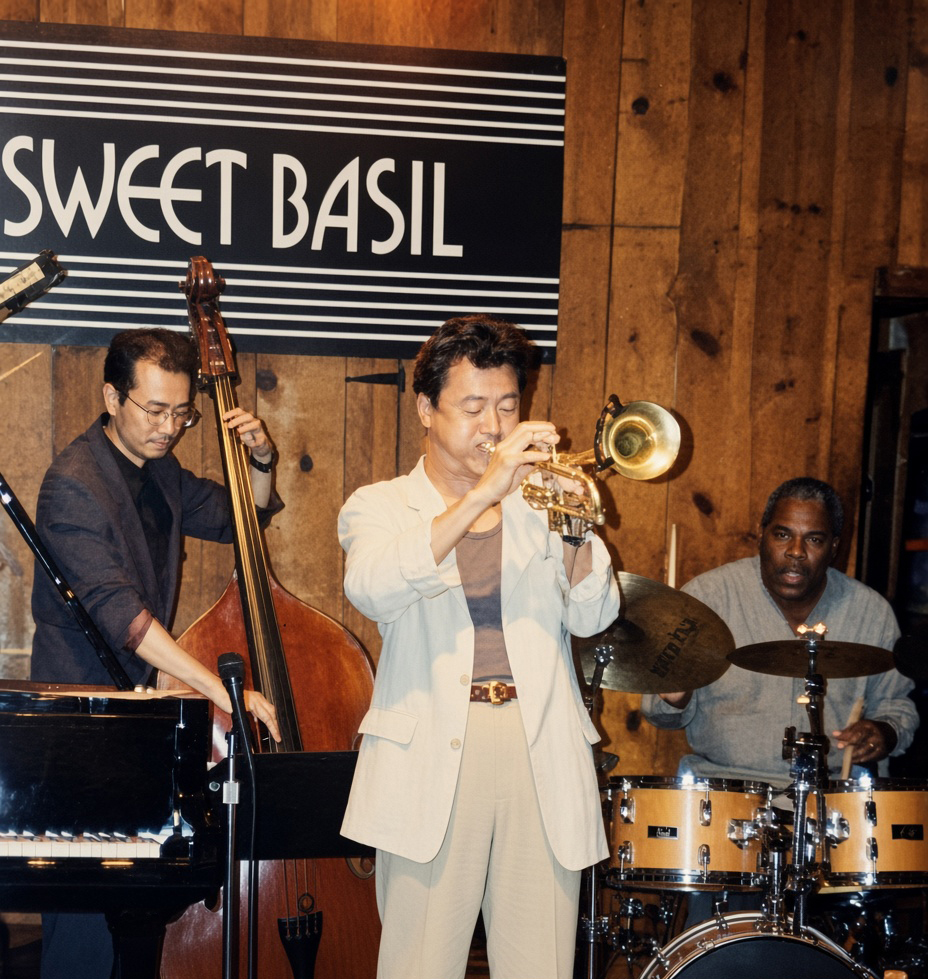 Yosuke Inoue, Terumasa Hino, and Michael Carvin, Sweet Basil, New York City, 1994
Explore your move to New York City in 1991.
I first moved to Tokyo in 1987 after I graduated college in Osaka. I spent a couple of years in Tokyo but felt that jazz is really American music. We Japanese people are always talking about American music, and I felt I needed to experience what it meant to play with people in New York City.
I was 25 years old and didn’t even think about how hard it was going to be. I was married at the time. I asked my wife if she would come with me and she agreed. So, we packed up and moved. I barely knew anyone over there. I knew a couple of Japanese people, but that was it.
I also had very little English. I didn’t even know where to go in order to find musicians to play with. I didn’t even know what I would eat. In the early ‘90s, Japanese restaurants in New York City were still very expensive, so it was out of the question to eat at them. So, I had to explore on my own to figure out what cheap restaurants I could eat at.
Eventually, I figured out where the jam sessions at the jazz clubs were. The first one I got involved in was The Village Gate. It had three floors. They’d have a jam session on the first-floor terrace on the weekends during the daytime. I used to live in Greenwich Village, which was walking distance. So, I’d go and play there.
I got to know the drummer Gregory Hutchinson and the bassist Dwayne Burno. They were also very young and starting their careers. We became friends. They’d start inviting me to their gigs little by little. Sometimes, the musicians would have jam sessions at their homes, too. I met many people that way, like the drummer Cindy Blackman and the pianist Matt Wilson. It was funny because they didn’t know me. I’d play and then they’d say “Wow, you sound better than I imagined.”
There were a few Japanese jazz musicians in New York City, but not too many. Masabumi Kikuchi was there. He was a special, crazy guy. He actually came down to my gig once and then invited me to his house. We went on to play together many times. He could be very sweet, and he really enjoyed doing standards.
In 1998, you got a major break when you were invited to record the What’s New LP with the Great Jazz Trio + 1, featuring Hank Jones. How do you look back at that experience?
I had been playing in the drummer Michael Carvin’s band since 1995. Michael was also in Terumasa Hino’s New York City band. Michael recommended me to Terumasa, and I joined his group as well. Early in my career in 1988, I played with Terumasa’s brother, the drummer Motohiko Hino. So, there was that connection, too.
I got to know Terumasa personally. Eventually, he got a gig playing at a sponsor party for the Atlanta Olympic Games in 1996. They put a band together including Terumasa’s musicians and Hank Jones. That’s where I played with Hank for the first time. Hank was supposed to just play two songs, but he decided to call out tune after tune, and we played for a long time. He seemed very happy.
After a while, he invited me to dinner in New York City. Then he invited me to his own gig at The Iridium. Little by little, we got to know each other. And then eventually I was asked to take part in the Great Jazz Trio + 1 album with Hank.
I think the record came out great, but I was so nervous. I had never played with the drummer Ben Riley before. I knew who he was and totally respected him. He plays very sincerely. But I found the confidence to play with those people who are part of jazz history. Hank was very encouraging. He helped me get known by many people.
You mentioned working with Motohiko Hino in the late ‘80s. He played a major role in your early trajectory. Tell me about your time with him.
I was much younger than Motohiko. I had just graduated from college. I wanted to play with the top players of Tokyo, which young people always want to do.
One night, I saw Motohiko play and I asked him, “Can I sit in?” And he said “Yeah.” It went really well. He said, “Wow, the young man can play jazz.” [laughs] He became interested in what I do.
Another night, Motohiko invited the great piano player Masahiko Satoh to play with him at a concert. Again, I asked, “Can I sit in?” [laughs] And I learned that Masahiko doesn’t like doing that, but somehow, he agreed and said, “Play one song.” So, I did.” After the show, he handed me a date and address, and told me to show up. I didn’t know what it was for. It turned out it was a recording session for Masami Nakagawa, the classical and jazz flautist. He was recording a new album in 1988 called Touch of Spring with Masahiko, who both played and contributed arrangements to it.
We were in a big recording studio and they said, “Put your headphones on and play the music.” So, I did and that was a big moment for me. After that recording, all of a sudden, many people started calling me.
What else can you tell me about your decision to return to Japan in 2004?
Unfortunately, I divorced my wife around that period. I’ve remarried since. But my first wife and I had many problems. She came to America because of me and then little by little, developed her own life there. I was doing my own thing as well with the jazz community.
Ultimately, I found it really hard to remain Japanese when I lived in America. I really wanted to do more of my own gigs as well, instead of being focused on being a sideman. I decided that Japan would be a better place to establish myself as a leader. And that has proven to be true.
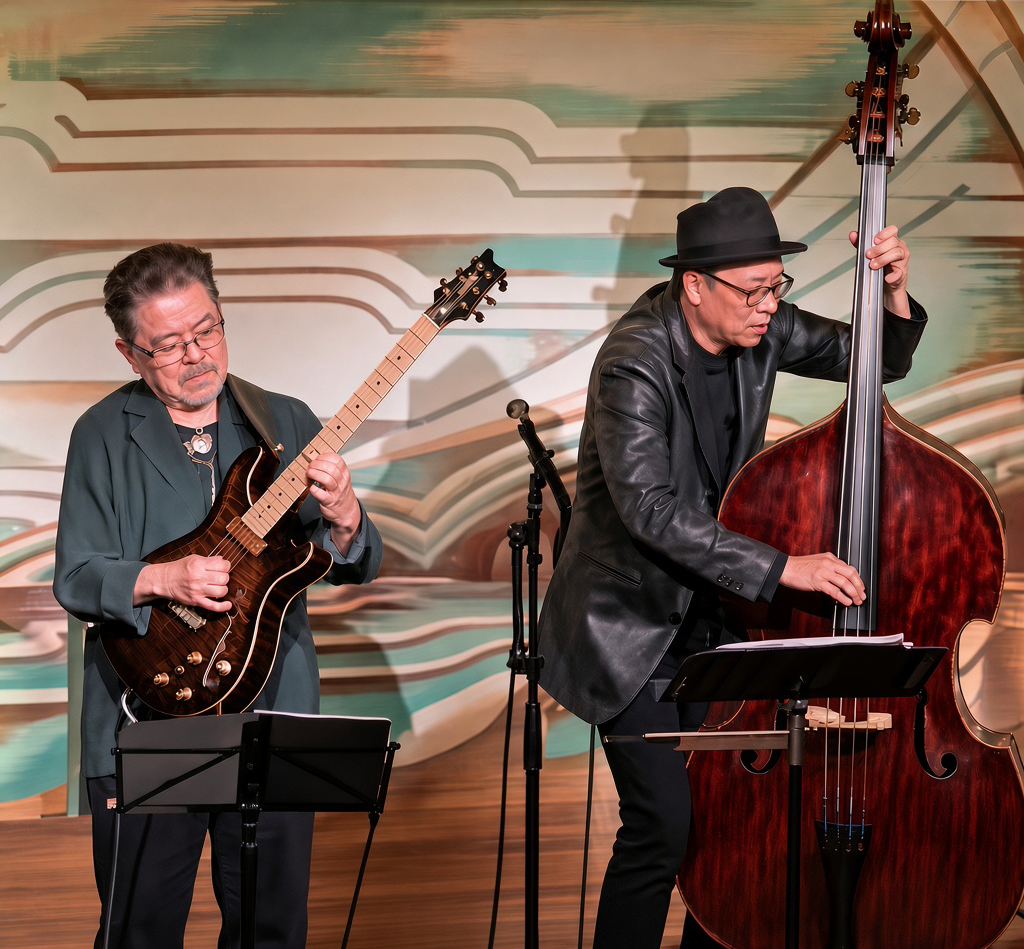 Kazumi Watanabe and Yosuke Inoue at Satin Doll, Tokyo, 2022 | Photo: Yosuke Inoue Collection
You’ve worked with Kazumi Watanabe a lot. How did you first meet and what was it like to collaborate with him?
I knew Kazumi’s work since I was 14. He would be on television and also do commercials. I remember hearing his 1980 album To Chi Ka and the song “Unicorn” from it, which was his big hit. I really thought his music was cool.
I first met Kazumi in 2004, through a gig with the pianist Akiko Grace. She actually lived in New York City at that time but had a gig in Tokyo. I performed live and recorded with her in Tokyo. During that period, she also had a concert with Kazumi, who played as a guest. It turned out he was looking for a bass player who could play straight-ahead jazz.
Kazumi at that point was more well known for fusion and crossover music. But he started with jazz guitar and wanted to revisit that side of his music. For a while, we played as a duo. And then he launched his Return to Jazz Project, which included making the album Jazz Impression with me in 2009.
It was so great to perform with Kazumi playing in the style of Wes Montgomery, which was very rare at that time. He knew so much about straight-ahead jazz. I was amazed. I thought we might explore a new type of fusion, but he wanted to play straight-ahead and it sounded great.
In 2024, Watanabe suffered a brainstem hemorrhage, tragically leaving him unable to play. What can you tell me about his current condition?
He almost died and we are very lucky he survived. He can’t talk or move, but I think he understands what people say. He has begun to move a finger a little bit. He can move his eyes and communicate with them. I think his consciousness is okay.
We really need people like Kazumi in this world performing. We need big stars like Kazumi who bring attention to this music. It’s people like Kazumi who help create scenes that last. We still have hope he can recover.
One of the songs on my Walking Alone album is “Enshu Tsubamegaeshi” by Kazumi. I asked his wife Koko Tanikawa for permission to do it and she agreed. I was told it also made Kazumi happy, so that was great.
You contribute to many high-profile anime soundtracks. What are your thoughts about your contributions to that realm?
It has been great to work with composers like Yuji Ohno on Lupin the 3rd. We also made several albums together as Yuji Ohno & Lupintic Five. He had a lot of jazz essence in his music, full of funky beats.
Yoko Kanno, the Cowboy Bebop composer, wanted an authentic swinging jazz sound that reminded people of New York City. She wanted me to play very aggressively, like we were at a jazz club. I thought that was cool.
I do a lot of work for television and film. It’s a great way to have people get to know who I am, and it helps bring people to my own music. So, I really appreciate the opportunities.
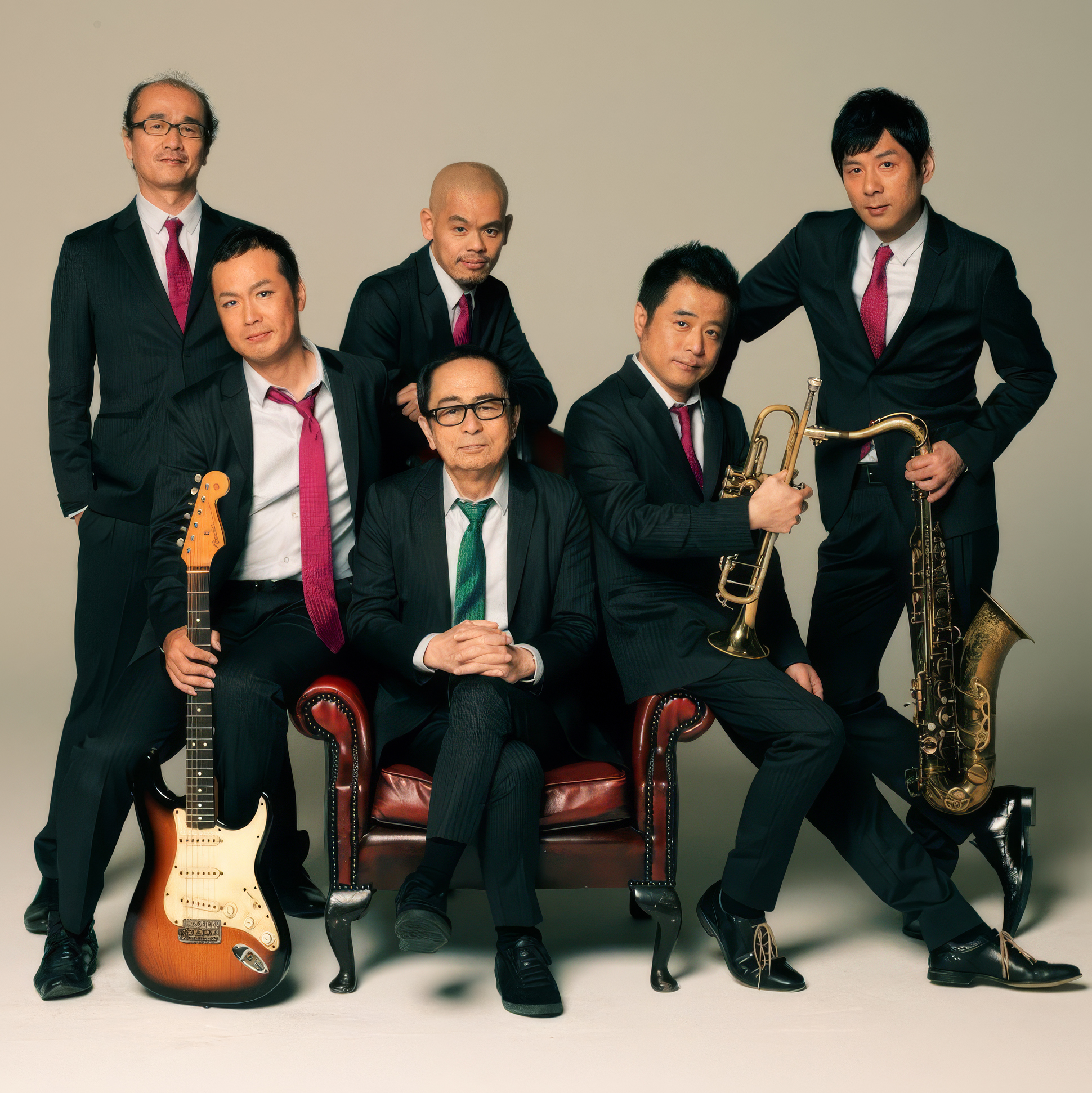 Yuji Ohno and Lupintic Five, 2015: Yosuke Inoue, Satoshi Izumi, Hisatsugu Suzuki, Yuji Ohno, Keiji Matsushima, and Yoshihito Eto | Photo: VAP Records
There have been a lot of terrible things to emerge in the social media era, but you’ve managed to make your feeds exclusively about music and silly fun. Describe your philosophy.
Social media is very easy to use for bad purposes, and I don’t want to do that. It’s a waste of time. Rather, I use social media to let people know what I’m doing. I completely avoid the dark side. I never discuss politics and I never put anyone down. I’m trying to be inspirational to people.
The other thing people should consider is how the social media algorithms work. Silly, enjoyable, fun posts tend to be shared a lot more than the darker posts some people do.
The Japanese jazz scene is responsible for some of the greatest music ever made in the genre. Yet it isn’t nearly as acknowledged worldwide as it deserves to be. Why do you feel that’s the case?
I think today we have issues with algorithms and copyrights. In Japan, we have an organization called JASRAC, which handles copyright management for music. For some reason, they have imposed copyright restrictions that prevent music from being shared widely outside of Japan. And this then affects the algorithms and prevents them from recommending Japanese jazz to people outside of the country that might want to hear it.
I have wondered why if we listen to Miles Davis or Weather Report, we never get a recommendation for artists such as Isao Suzuki, Toshiyuki Miyama & The New Herd, Kazumi Watanabe, or Hiromasa Suzuki in America.
Yeah. It’s because JASRAC has set up protections so the music doesn’t go out and is monetized only in Japan. I wish they would ease up on this so the music could get recommended worldwide. It’s really strange and a big problem.
When I look at my YouTube metrics, I can see what countries access my channel, and it’s 98% from Japan. I have tried to promote my music across Europe and America. And when I pay to do that, it does get out there. And then as soon as I stop paying, it’s over. I have no answer to this situation, but I hope it changes.
What motivates you to remain so active, vibrant, and optimistic about what you do?
I really love the music I play. It’s based on a respect for people that came before me. It’s an authentic thing. People like me evolve the music over time. We have many possibilities for developing the music.
I also know I’ll never really be satisfied with what I’ve done. I always know there is a new area to explore and more for me to learn. Those things drive me to play more, practice more, and study more.
In addition, I think it’s very important to play with young musicians. They teach me a lot about new ideas and directions. I’m 62, but age doesn’t matter when it comes to people influencing one another. There are now teenagers who are listening to jazz and really excited by it.
So, I think the lesson for everyone is to respect the past but not look back all the time. Think about new possibilities and keep pushing things forward.